
Did you know that 50% of founders see a significant increase in signups after their Product Hunt launch? On top of that, 54% of them establish valuable partnerships within the tech industry.
With its 130,000 daily visitors, Product Hunt has become, since 2013, an essential platform for startups looking to gain visibility. Every day, between 20 and 40 products compete for the coveted "Product of the Day" title, creating intense but stimulating competition.
That said, success is not guaranteed: only 26.5% of launches attract between 500 and 1,000 users, while 10.2% manage to attract between 2,000 and 5,000. Success depends on a carefully prepared strategy.
This complete guide details, step by step, how to plan and execute a successful Product Hunt launch, maximize your visibility, and turn this opportunity into a real springboard for your startup.
What is Product Hunt and why use it
The Product Hunt site explained simply
Founded in 2013, Product Hunt has established itself as a community platform where creators share their new tech products. This free platform allows startups to showcase their innovations to a tech-passionate audience, mainly composed of early adopters, entrepreneurs, and potential investors.
Each day, products are ranked linearly on a "first come, first served" basis. However, their final ranking depends on the number of votes received over the course of the day. The platform mainly hosts four categories: tech products, games, books, and podcasts.
The benefits of a successful launch for your startup
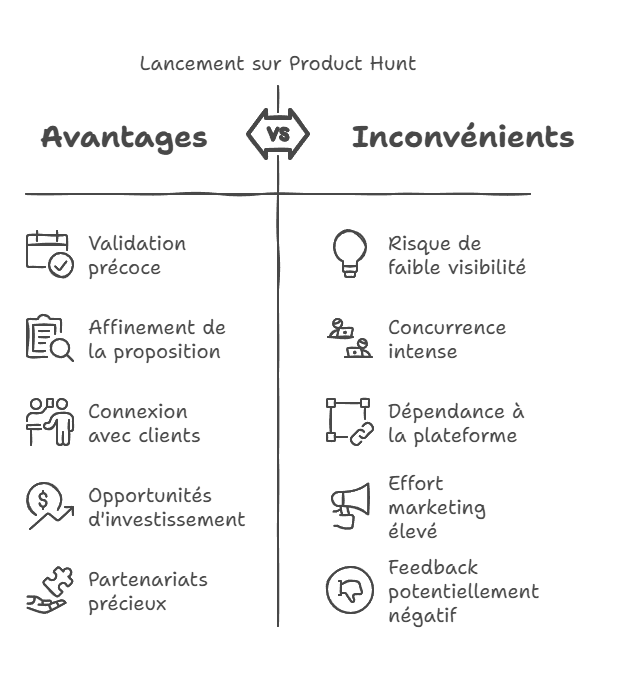
A successful launch on Product Hunt offers several significant benefits. First, the platform provides early market validation and helps refine your value proposition. It also makes it easier to connect with potential customers, investors, and industry peers.
Well-known companies like Loom, Zoom, Grammarly, and GitLab have seen remarkable success thanks to their launches on the platform. Beyond that, 54% of services launched manage to establish valuable partnerships within the tech industry.
What you can realistically expect in terms of results
In terms of traffic, the data shows that 26.5% of launches attract between 500 and 1,000 users, while 22.4% generate between 1,000 and 2,000 visitors. Only 10.2% of the top-performing launches manage to attract between 2,000 and 5,000 users.
When it comes to conversions, 50% of founders observe an increase in signups after their launch. More precisely, 30% notice a significant rise, while 16% see no notable peak. The traffic conversion rate varies considerably across products, ranging from 20-30% above expectations for some, and up to 50% below for others.
It's important to note that 56% of launches receive no media coverage. However, the platform offers other valuable benefits: it provides constructive feedback from the tech community, validates the concept, and delivers important social proof through the Product Hunt badge, which is particularly valued within the startup ecosystem.
Preparing your product for launch
Thoroughly preparing your presentation assets is an essential step for a successful Product Hunt launch. On average, startups that excel on the platform invest between 50 and 120 hours in this preparation phase.
Check that your product is a good fit for Product Hunt
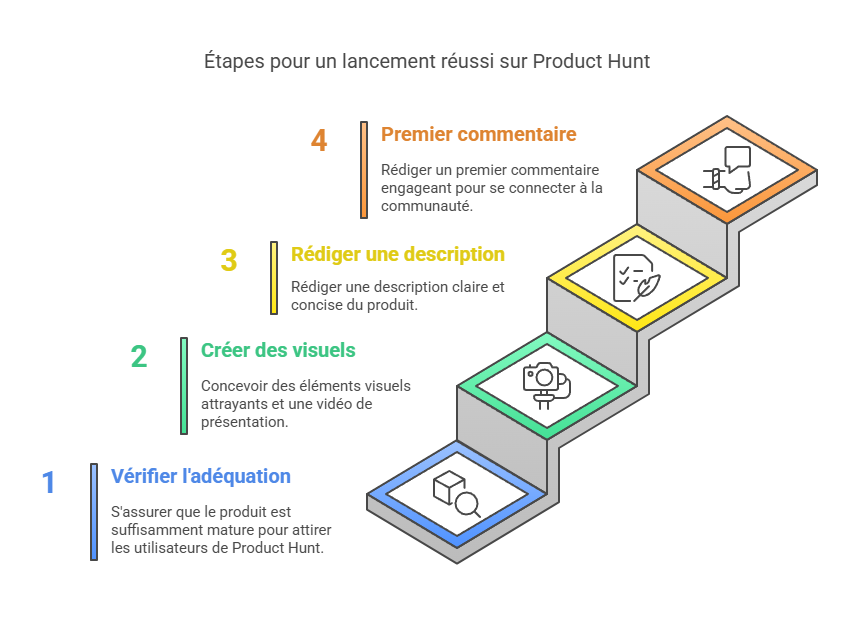
To maximize your chances of success, the product must be mature enough to grab the attention of the platform's tech-savvy users. That said, many founders make the mistake of waiting too long before launching. Product Hunt provides valuable signals on market expectations, so it's better to launch early and often.
Create simple, short visuals and a video presentation
Visual elements play a decisive role in the success of a launch. For the main thumbnail, Product Hunt recommends a 240x240 pixel format. An animated GIF can be effective, provided it isn't too distracting. Otherwise, a classic logo remains preferable.
The image gallery requires at least two visuals in a 1270x760 pixel format. The first visual is particularly important because it will be used as the meta image for social sharing.
When it comes to video, statistics show that 53% of products that reached "Product of the Day" status included one. Two formats stand out in particular:
- A demonstration of the product's features
- A presentation by the founding team
Write a description of your product
The description consists of several key elements:
The product name must be simple, with no emoji or extra description. For example, "Meow On-Demand App" is acceptable, unlike "The best cat app".
The tagline (60 characters maximum) must clearly present the value proposition, with no marketing fluff. A good tagline would be: "Send your friends a voicemail meow from a real cat".
The detailed description (260 characters maximum) lets you expand on the product's features and benefits. It must stay concise while highlighting the unique value proposition.
The first comment represents an essential opportunity to build a connection with the community. It allows you to introduce the team, explain how the project came about, and highlight what differentiates the product from the competition.
Developing your community strategy
A successful Product Hunt launch requires a solid community strategy. With an average of 130,000 daily visitors, the platform offers startups a unique opportunity to reach an international audience.
Identify and engage influencers in your niche
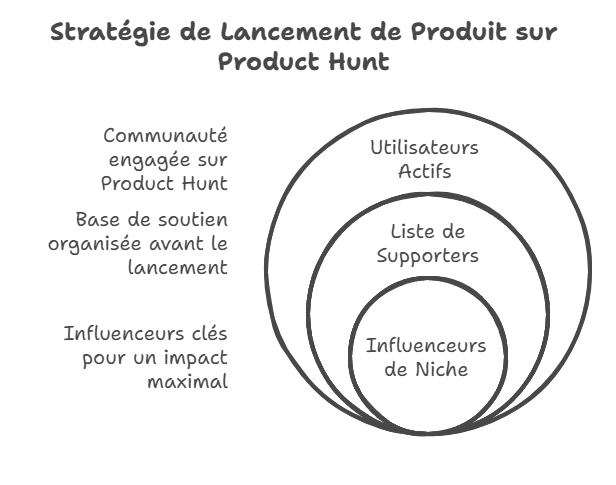
To maximize the launch's impact, it's essential to identify the relevant influencers in your sector. These people, often called "hunters", are active members of the Product Hunt community who have built a strong reputation through their product recommendations.
To spot these key influencers:
- Analyze similar launches in your category
- Examine their "hunting" history and engagement rate
- Assess their alignment with your niche and your values
Build a supporter list before the launch
Building a support base ideally starts two months before the launch. This methodical approach helps identify and engage three essential categories of supporters:
- Active Product Hunt users
- Makers who have already launched their products
- Members of your professional network
Maker profiles are particularly valuable because their votes generally carry more weight in the Product Hunt algorithm.
Use LinkedIn for vote pledges
LinkedIn is a particularly effective channel for securing vote commitments. The recommended strategy unfolds in two phases:
First, fifteen days before launch, reach out to your LinkedIn network to identify people willing to support your product. This first campaign aims to build a list of committed supporters.
Second, on launch day, focus your efforts only on people who have pledged their support. This targeted approach optimizes the impact of your actions without being flagged as a spammer by the platform.
It's particularly advisable to prioritize contacts who already have a Product Hunt account. The platform's algorithm gives more weight to interactions from established profiles, while it can penalize votes from recently created accounts.
Planning your launch strategy
Precise timing and coordination are essential for a successful Product Hunt launch. Strategic planning helps optimize visibility and community engagement.
Choose the best day to maximize visibility
Tuesdays, Wednesdays, and Thursdays show the highest engagement rates on the platform. However, these days are also the most competitive. For a first launch, Friday offers an excellent compromise between visibility and moderate competition.
A key element: schedule the launch at 12:01 AM PST precisely. This strategic time guarantees maximum exposure on the homepage for a full 24 hours. It's also wise to avoid the first week of the month, as that period attracts more competition.
Collaborate with an influential hunter
While Product Hunt no longer officially favors influential hunters, their impact remains significant. Statistics reveal that 79% of featured posts come from self-hunting, while 60% of products ranked number 1 follow this same approach.
Build your support team
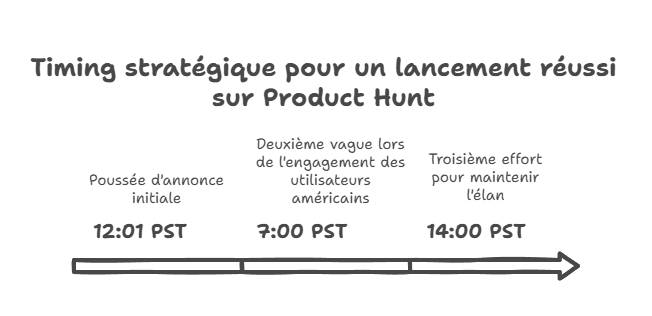
To maintain a steady flow of engagement, it's advisable to segment actions into three main phases:
- First push at 12:01 AM PST for the initial announcement
- Second wave at 7:00 AM PST when American users come online
- Third effort at 2:00 PM PST to sustain momentum
Prepare your action timeline
Preparing the launch requires careful coordination. It's recommended to start preparations at least a month in advance. During this period, several key actions must be planned:
- Schedule social media posts
- Prepare segmented emails for different time zones
- Organize teams for managing comments and questions
In addition, plan a contingency strategy in case of technical issues. A static landing page can serve as a backup solution if the main site runs into difficulties.
Mastering the psychology of voting on Product Hunt
The quality of votes on Product Hunt outweighs their quantity in importance. The platform's algorithm particularly favors engagement from established members who regularly participate in discussions.
Why people vote (or don't vote)
Early adopters form the heart of the Product Hunt community. These users actively seek out innovative products and willingly share their opinions with their networks. Their engagement matters because they:
- Validate the product concept
- Contribute to initial development
- Become the brand's first ambassadors
That said, certain factors can discourage votes. Accounts newly created on launch day raise suspicion from the algorithm. Plus, simultaneous votes coming from the same location can trigger anti-spam filters.
How to frame your requests for support
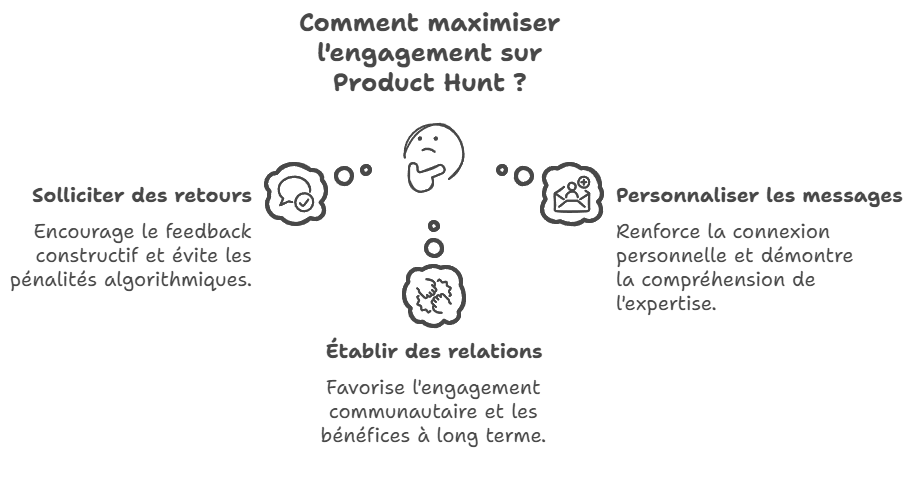
The way you approach the community significantly influences the launch's success. A personalized approach is essential, avoiding generic messages that hurt credibility.
To maximize authentic engagement:
- Prioritize feedback: Ask for constructive feedback rather than direct votes. The algorithm can penalize explicit vote requests.
- Personalize messages: Address each member by name and show an understanding of their specific expertise.
- Build lasting relationships: Devote time to community engagement before the launch. The benefits often extend beyond Product Hunt.
In addition, it's advisable to send a follow-up email three days after the first contact, inviting recipients to spend a few minutes voting and commenting on other products on the platform. This account "warm-up" approach significantly increases the value of their later votes.
Executing your launch on the big day
The first four hours after launch often determine success on Product Hunt. During this initial period, the platform displays new products randomly, providing fair visibility to each launch.
The first hours
To maximize impact, the launch must be scheduled precisely at 12:01 AM PST. The main goal is to secure between 30 and 100 votes during the first hour. This initial momentum proves decisive because the leading positions are generally won between 12:01 AM and 1:00 AM.
During these critical hours, Product Hunt hides the number of votes for each product, allowing users to assess launches objectively without outside influence. This period represents a unique opportunity to build a significant lead over the competition.
Reply to comments and questions
Responsiveness to comments significantly influences the ranking algorithm. To optimize engagement:
- Reply systematically to every comment
- Mobilize several team members to bring varied perspectives
- Actively solicit feedback on features
- Maintain constructive dialogue throughout the day
Mobilize your network at the right time
To maintain steady momentum, it's advisable to organize three main mobilization waves:
First push: Immediate activation at 12:01 AM PST to generate initial momentum Second wave: Mobilization at 7:00 AM PST, coinciding with American users coming online Third effort: Boost at 2:00 PM PST to consolidate positioning
In addition, if you have a substantial email list, consider segmenting your sends into ten batches spread across the day, ideally organized by time zone. This approach ensures staggered, sustained participation.
Amplifying your launch's impact
Strategic post-launch amplification often determines the difference between a modest success and a resounding triumph on Product Hunt. A methodical approach is essential to maximize your product's reach.
Use social media effectively
To optimize visibility on social media, several tactics prove particularly effective. First, it's advisable to be active on these platforms for 4-5 months before the launch. This prior presence helps build an engaged audience.
Posts must follow certain fundamental principles:
- Favor short, punchy messages
- Use the same visuals as on the Product Hunt page
- Mention @ProductHunt in posts
- Limit hashtag use to keep attention on the product link
In addition, running contests or giveaways tied to the product can significantly boost engagement. Partnerships with influencers in the sector also amplify the launch's reach.
Activate your community by email
The email strategy plays a decisive role in amplifying the launch. To maximize its impact, it's recommended to segment the list into ten distinct groups, divided by time zone. This approach guarantees continuous mobilization throughout the day.
To drive engagement, several actions prove particularly effective:
- Create a dedicated landing page with special offers for launch day
- Encourage sharing of the Product Hunt link with professional networks
- Regularly distribute updates, especially at important milestones such as reaching 100 votes
The data shows that companies that maintain active communication with their community during the launch achieve a higher engagement rate. The key lies in personalizing messages and creating a sense of exclusivity around the launch.
Conclusion
A successful Product Hunt launch rests on careful preparation and strategic execution. Startups that excel on the platform dedicate, on average, 50 to 120 hours to their preparation, an investment that pays off.
Success largely depends on three key factors: a striking visual presentation, an engaged community, and optimal timing. Founders who follow this methodical approach significantly increase their chances of reaching the coveted "Product of the Day" status.
The platform offers much more than a simple showcase for new products. It represents a unique opportunity for market validation, valuable feedback from the tech community, and strategic connections with potential investors.
We've created a complete guide to launching on Product Hunt, but also on Reddit, Facebook groups, and more. Sign up for the newsletter to receive the full guide + a list of 25 sites where you can launch your product, straight to your inbox.
Finally, success on Product Hunt often marks the beginning of significant growth for startups. Founders who invest the necessary time in preparation, maintain an authentic presence, and stay responsive throughout the process position their product for maximum impact on this influential platform.
FAQs
Q1. What are the benefits of a successful Product Hunt launch? A successful Product Hunt launch offers increased visibility, early market validation, connections with potential customers and investors, and valuable feedback from the tech community. It can also lead to a significant increase in signups and establish valuable partnerships within the industry.
Q2. How do you effectively prepare your product for a Product Hunt launch? To prepare your product, make sure it is mature enough but don't wait too long to launch. Create attractive visuals, including a main 240x240 pixel thumbnail and at least two 1270x760 pixel images. Write a concise, punchy description, and consider including a presentation video, since 53% of "Product of the Day" products feature one.
Q3. What is the best strategy for mobilizing your community at launch? Start by identifying influencers in your niche and build a supporter list about two months before launch. Use LinkedIn to secure vote pledges. On launch day, organize three mobilization waves: at 12:01 AM PST for the initial momentum, at 7:00 AM PST to reach American users, and at 2:00 PM PST to sustain momentum.
Q4. How do you optimize your product's visibility on launch day? Schedule your launch at 12:01 AM PST precisely to maximize exposure. Aim for between 30 and 100 votes during the first hour. Actively respond to all comments and questions throughout the day. Use social media effectively by publishing short, punchy messages, and activate your community by email by segmenting your sends by time zone.
Q5. What's the recommended preparation time for a successful Product Hunt launch? Startups that excel on Product Hunt dedicate on average between 50 and 120 hours to preparing their launch. It's recommended to start preparations at least a month in advance to coordinate every aspect of the launch, from creating visuals to mobilizing the community.