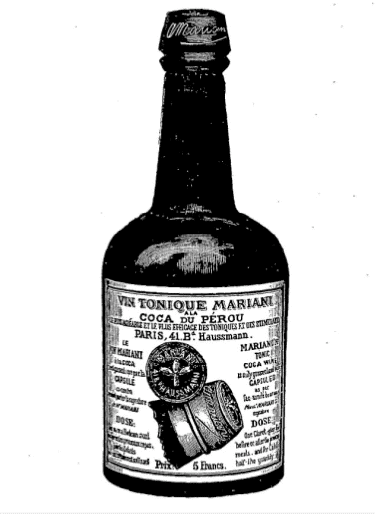
Vin Mariani bottle 1894 - The original Coca-Cola precursor

Coke

comes from Corsica

Or how we slaughter
our own innovations

Ex Cura Theoria Nascitur: How Europe invents the future and lets others exploit it

The Apple Theory, The Cathedrals, Chance and Necessity.

Or why everything you've been taught about innovation is wrong.

Scroll to travel through time

The year is 1863

A Corsican pharmacist named Angelo Mariani...

...has just concocted something that will change his life and, without him yet knowing it, inspire one of the most profitable companies in human history. He blends Bordeaux wine with coca leaves imported from South America, a product he markets under the name Vin Mariani.

Success is immediate, almost embarrassing in its scale. Pope Leo XIII keeps a flask of it in his cassock and awards Mariani a gold medal. Queen Victoria orders it regularly. Thomas Edison, Sarah Bernhardt, Jules Verne, American president William McKinley, all consume it and publicly praise its merits.

1886

Twenty-three years later, on the other side of the Atlantic, an Atlanta pharmacist named John Pemberton observes this European success with the calculating interest of a man looking for a commercial opportunity. He decides to create his own version of Vin Mariani, but without alcohol this time, to get around local prohibition laws.

The transformation begins

Pemberton keeps the central principle (the combination of stimulants and pleasure of taste), modifies the proportions, adds sugar and flavors, changes the name. "Vin Mariani" first becomes "French Wine Coca", a transparent homage to the original, then simply "Coca-Cola" once alcohol is definitively removed from the formula.

Pemberton, ironically, dies ruined two years after this creation, in 1888, without having understood the value of what he had made. Asa Candler, a more skillful or simply luckier businessman, buys the formula for $2,300 in 1891 (about $76,000 today, which is still trivial), methodically builds a continental and then planetary distribution machine, standardizes the product, unifies the message, creates the consumption habit, and transforms this adaptation of a French recipe into a global symbol of America itself.

$2,300 to planetary empire

History rewritten

Today, in 2025, if you ask one hundred people on the street, ninety-nine will tell you that Coca-Cola comes from the United States, that it was invented in Georgia, that it is a fundamentally American product in its essence and design. Nobody will spontaneously mention Corsica, Angelo Mariani, or that tonic wine that circulated in Parisian salons and European royal courts for decades.

History has been rewritten, not by a deliberate conspiracy, but by a much more mundane and much more powerful mechanism: the one that transforms an invention into mass usage, that builds the distribution machine capable of reaching hundreds of millions of consumers, that creates the daily habit and controls the cultural narrative around it, becomes the symbolic owner of the idea, regardless of its actual technical lineage.

This story raises the following question:

if an invention born in France can become a planetary American symbol, then the real subject of innovation is clearly not "who invents what", but rather "who transforms an invention into a diffusion empire, who writes the final history, and above all, why some countries excel at this transformation while others excel at forgetting their own creations".

📚

You're sitting in a lecture hall

at a major French business school

during a course titled "Innovation Management"

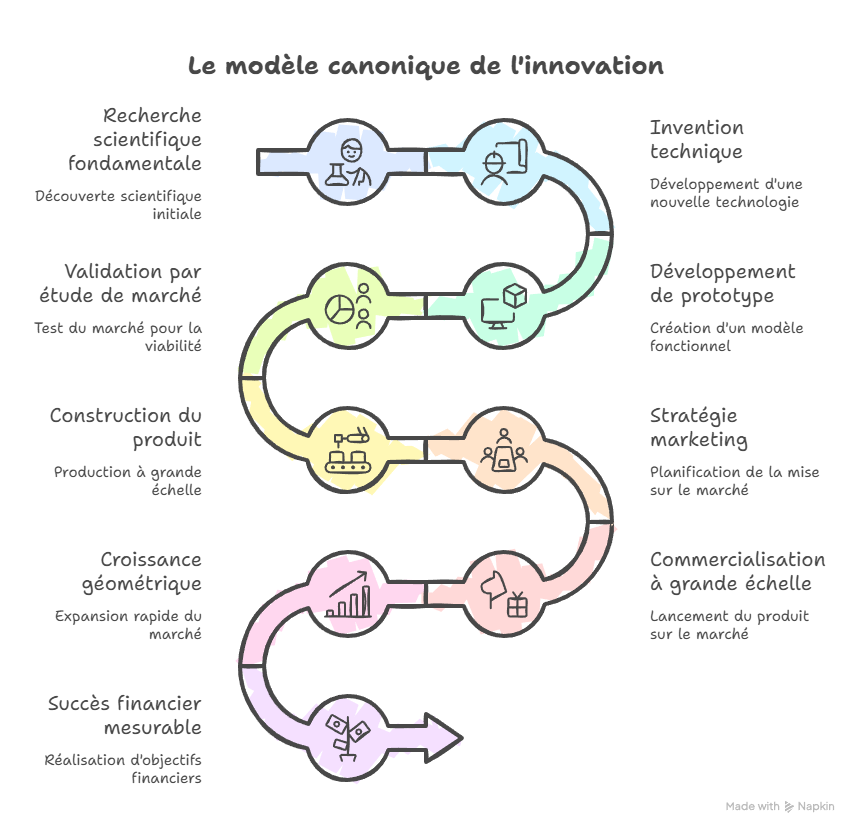
The professor presents you with the canonical model of innovation as it has been taught for decades: fundamental scientific research, technical invention, prototype development, validation by market research, product construction, marketing strategy, large-scale commercialization, geometric growth, measurable financial success.

Each step follows logically from the previous one, each phase has its performance indicators, its validated methodologies, its best practices documented in hundreds of management books.

Linear innovation process. Canonical model taught in management

The illusion of control

This model is enormously appealing because it gives the illusion of control, that extremely comforting feeling that it's enough to follow the method rigorously to obtain the desired result, a bit like a cooking recipe that would guarantee the perfect dish if you scrupulously respect the proportions and cooking times.

It tells a beautiful story, with a clean narrative arc that begins with a brilliant intuition, moves through obstacles surmountable by perseverance and method, and ends with a predictable triumph. It also sells extraordinarily well, feeding a complete ecosystem of continuing education programs, innovation consulting firms, support programs, incubators, accelerators, labels and certifications.

The central problem,

which should jump out at anyone who examines the concrete history of major innovations of the last two centuries instead of settling for the sanitized versions presented in business case studies, is that this linear model systematically confuses narrative order (the way the story is told after the fact to make it understandable and inspiring) with causal order (the actual sequence of events, fumblings, accidents, detours that actually produced the innovation in question).

This confusion is not a technical detail reserved for nitpicking historians. It is the original sin of almost all contemporary discourse on innovation, the source of billions of euros wasted every year in Europe on initiatives that conscientiously apply a fundamentally flawed method.

💡

Behind every "predictable" innovation

lies a chaotic story of errors, accidents and detours. The true art of innovation is not following a plan, but learning to navigate uncertainty.

The Apple Theory

Let's take a concrete example to illustrate the gap between the model that is taught and the reality that is observed.

🍎

In the academic model, a rational entrepreneur who wants to create...

...a better apple

🔬

How innovation works, from an apple's point of view

Academic theory vs. historical reality

The apple "researcher"

Systematic theoretical approach

The entrepreneur would begin with an exhaustive market study: six to twelve months of qualitative interviews, quantitative panel analyses, psychographic segmentation to identify precisely what "the market" expects. We would probably discover that consumers want an apple that is "crunchy but not too hard", "sweet but perceived as healthy", "red but with natural variations".

All of this would be compiled into an eighty-page specifications document. Next would come the design thinking workshops with their colorful sticky notes, their brainstorming sessions, their conceptual prototypes tested on focus groups.

Then the actual research and development phase: a mandate to a laboratory to develop a genetically optimized variety. Three to five years of work. Patents. Scientific publications. Finally, the launch: massive communication campaign, packaging designed according to the latest trends, mobilized influencers, negotiation with major retailers for strategic shelf placements at the end of the aisle.

Standard academic methodology
🌱

The apple "finder"

The creative chaos of the real world

Now, here's how innovation actually works in the vast majority of documented historical cases. A fourteen-year-old teenager lives near a family orchard, not because he nurtures early entrepreneurial ambition, but simply because his parents live there and he spends his afternoons watching the trees because he's bored.

One day, out of pure empirical curiosity, he notices that one particular branch, probably resulting from a random genetic mutation or an accidental cross-pollination, produces noticeably larger fruit with a slightly different color. Without any formal knowledge of plant genetics, he takes cuttings from this odd branch and plants them elsewhere in the orchard, just to see what will happen, without any specific hypothesis or commercialization plan.

Multiple attempts

Most of his attempts fail: some cuttings die, others produce inedible apples. But one of them, against all expectations, produces an extraordinary apple: firm and crunchy even after several weeks of storage, distinctively fragrant, that doesn't brown quickly in the open air.

Accidental innovation
Chaos to Creation

The boy tells his neighbor about his find

Out of simple pride. The neighbor, impressed by the taste, tells another neighbor. Within three months, without any formalized marketing strategy, the whole village plants this variety. Within a year, a regional nurseryman who happens to pass through the village notices the enthusiasm and begins to commercialize the variety.

Within five years, it is the most planted apple in the region, then in the country. No one knows the name of the teenager who made the first cutting. History will be rewritten in retrospect, attributed to a respected agronomist who simply documented the variety a few years later.

💡

Real innovation is not a rational, predictable process, but a chaotic mix of curiosity, accidents and organic diffusion. True genius is not in planning, but in the ability to recognize and amplify the anomalies that emerge spontaneously.

🔍

This second story is not romantic fiction.

A recurring pattern

This is, with minor variations in detail, the way most of the fruit varieties we consume today came about, the way livestock breeds emerged, the way the artisanal techniques that preceded the industrial revolution developed, and even the way most major technological innovations still work today.

The essential characteristics

What characterizes this second story is not the absence of intelligence or competence on the part of the actors involved, it is the central place given to chance, to experimentation without a precise hypothesis, to selection by reality (the apples that don't work are eliminated immediately, without a decision committee or bureaucratic justification), and above all, it is the fact that theorization, formalization, coherent explanation always come after the fact, once the object has already proven its usefulness and commercial viability in the real world.

?
🎯
Experimentation, Selection, Theory
📖

Selection by failure

The methodical critique of the linear model

The non-academic expert

Nassim Nicholas Taleb, in his book Antifragile published in 2012, spent several hundred pages methodically demolishing the illusion of the linear model we just described. This intellectual violence is not gratuitous. It comes from the fact that Taleb is neither an academic economist protected in a university, nor a consultant who lives off the perpetuation of comforting myths. He is a former derivatives trader who spent twenty years betting real money on intuitions he did not always perfectly understand at the moment he formulated them, and who therefore developed a visceral allergy to beautiful theoretical discourse that collapses on first contact with reality.

The central idea

Taleb's central idea, which he formulates in dozens of different ways throughout his work to drive the point home and eliminate any possibility of misunderstanding, is that real innovation does not come from the conscious intention to discover something specific, but from repeated and systematic exposure to chance, to accepted error, and to relentless selection by the real world.

This idea is not simply counterintuitive. It is directly opposed to everything taught in management schools, to everything told in the hagiographic biographies of successful entrepreneurs.

And Taleb adds a crucial nuance: in the vast majority of rigorously documented historical cases, it is not the theorists, academic researchers, or credentialed experts who produce the major innovative breakthroughs. It is the practitioners, the tinkerers, the artisans, the entrepreneurs who try something without institutional authorization, who fail quickly and cheaply, who try again with variants, who progressively refine through trial and error until something finally works in a reproducible way.

Theory after, not before

Theory, in this scheme, is not useless. But it comes after, not before. It observes what has survived the market's natural selection, it formalizes the observed regularities, it rationalizes the process retrospectively to make it transmissible and teachable. But it does not create ex nihilo.

Taleb sums up this idea in a deliberately provocative Latin phrase: ex cura theoria nascitur, theory is born from practice, and not the other way around as the dominant academic model naively assumes.

The jet engine example

Theory vs. historical reality

Take the example of the jet engine in aviation. We have all learned, or at least we all believe we know, that the development of jet engines follows logically from advances in thermodynamics, fluid mechanics, materials science. In short, that scientific theory preceded and enabled the technical application.

The technology historian Philip Scranton of Rutgers University has shown, with archival documents to back it up, that this is rigorously false. We built and used jet engines for decades in an entirely experimental way, by successive adjustments, transmission of tacit know-how between senior and junior engineers, trial and error on real prototypes, without anyone really understanding the complete theory that governs their operation.

The engineers who worked at Rolls-Royce, General Electric or Pratt & Whitney in the 1940s and 1950s knew how to twist certain parts, adjust air flows, calibrate combustion temperatures to obtain the desired thrust without the whole thing exploding in flight. They passed on this knowledge in an almost artisanal way, through direct apprenticeship, observation, imitation, empirical rules such as "if you see such-and-such vibration, then tighten such-and-such bolt by a quarter turn". The formalized theory came long after, to satisfy the institutional need for academic rationalization.

The Gothic cathedrals

Engineering without equations

The Gothic cathedrals of medieval Europe offer perhaps the most spectacular illustration of this principle. These structures seem geometrically impossible, feats of engineering that should logically require sophisticated mathematical calculations. Yet they were built by master builders who, for the vast majority of them, knew no formal mathematics.

The French historian Guy Beaujouan, a specialist in medieval science, has established that before the 13th century, there were probably no more than five people in all of Western Europe capable of performing a simple arithmetic division. So how did they build edifices that are still standing eight hundred years later?

Through accumulation of empirical rules, oral and visual transmission of tested techniques, learning through direct observation and imitation, safety margins built in by precaution rather than by calculated optimization. Villard de Honnecourt, a French 13th-century architect, left notebooks full of practical instructions: "to visualize a triangle, think of a horse's head" or "for this vault, use such-and-such wooden template that you make this way". No equations. No formal geometric demonstration. Just gestures that work because they have been tested, refined across dozens of construction sites, because the ones that didn't work produced memorable collapses from which everyone drew lessons.

⚖️

The golden rule of innovation

The general rule that Taleb invites us to internalize, and that should guide any innovation policy worthy of the name, is: massively tolerate local errors (many small acceptable losses, distributed across many independent actors), but absolutely prevent systemic errors (a single large centralized error that destroys the entire system).

HEALTHY

A thousand startups that fail quickly after burning 50,000 euros each

CATASTROPHIC

A national plan that concentrates 500 million euros on a single project

France and Europe historically excel at the second approach (large centralized programs, national champions selected by committees, massive funding of a few projects deemed strategic by experts) and chronically underinvest in the first (multiplication of small decentralized attempts, social acceptance of rapid failure, patient but demanding capital broadly distributed).

🇫🇷

The recurring pattern

French history revisited

Back to Coca-Cola

Let's now come back to our Coca-Cola story, because it is not an isolated anecdote in French history. It represents a recurring pattern, almost a historical curse if we don't understand the mechanism that underlies it.

France (and more broadly continental Europe) has an extraordinary track record of major inventions that transformed the modern world: cinema (Lumière brothers, Lyon, 1895), photography (Nicéphore Niépce, 1826), pasteurization (Louis Pasteur, 1865), reinforced concrete (Joseph Monier, 1867), the pneumatic tire (Édouard Michelin, 1895), the high-speed train (TGV, 1981), Minitel (1982, precursor of consumer Internet), radar (Henri Busignies), the cloth from Nîmes that would become American denim, and many others.

French inventions and innovations throughout history

What is striking is not just the impressive quantity of inventions,

French inventions, global perception

It is mainly the fact that most of these innovations, although they were technically created in France, are today perceived in the global collective imagination as American, Japanese, German, or simply as "universal" without any specific national origin attached to them.

⚠️

The real problem

Not a lack of inventors, but of transformation

France's problem is clearly not a lack of inventors, researchers, brilliant engineers, or pure technical innovation capacity. It is a problem of transforming invention into a diffusion empire, of capturing the economic and symbolic value that flows from this diffusion, and above all of building a cultural narrative that anchors innovation in a recognizable and exportable national identity.

🎯

To put it more directly: France knows how to invent, but does not know (or no longer knows) how to transform its inventions into dominant market standards, into global brands, into durable industrial ecosystems.

A few French inventions

1826 Photography (Nicéphore Niépce)
1865 Pasteurization (Louis Pasteur)
1867 Reinforced concrete (Joseph Monier)
1895 Cinema (Lumière brothers)
1895 Pneumatic tire (Édouard Michelin)
1981 TGV (high-speed train)
1982 Minitel (precursor of the Internet)
18?? Jeans: cloth from Nîmes (American denim)
🤔

Why this gap?

Three major structural explanations

Why this gap? Three major structural explanations, which are neither historical fatalism nor immutable cultural defects, but institutional choices and economic incentives that we could change if we collectively decided to.

First explanation

Global diffusion capabilities

Global diffusion requires capabilities that have nothing to do with technical invention itself. Diffusing at scale demands patient but abundant capital (which accepts losing its initial investment in eight cases out of ten, but earns enough on the two survivors to largely compensate), physical or digital distribution channels capable of reaching hundreds of millions of potential customers, sustained commercial aggressiveness over years even in the face of regulatory or cultural obstacles, an ability to standardize the product without losing its essence to allow mass production, a brand strong enough to create an emotional preference in the consumer beyond objective technical features.

Many French innovations have been copied, adapted, industrialized elsewhere by actors who mastered these diffusion skills better than the original inventor, then commercialized under a new identity that progressively erases the memory of the origin.

🎯

Second explanation

The capture function

France systematically underestimates the "capture" function in the life cycle of an innovation. To capture means transforming a technical invention into a durable asset: a company that survives beyond its founder, a brand that becomes synonymous with the product category itself, a technical standard adopted by the industry that creates path dependency, a cultural narrative that associates the innovation with a specific place, era, and national identity.

🚀

Silicon Valley excels at this capture, not through superior genius or mysterious cultural exception, but through the accumulation of concrete institutional mechanisms: an unusual density of experienced entrepreneurs who become investors and mentors, a culture of inter-company mobility that diffuses best practices, social acceptance (and even valorization) of entrepreneurial failure that encourages repeated risk-taking, geographic proximity that facilitates chance encounters and impromptu collaborations, a liquid labor market that allows the rapid recruitment of needed skills. It is not magic. It is reproducible institutional engineering.

Third explanation

The dominant global perception

The dominant global narrative associates "innovation" with the present and the future, not with historical heritage. When you think about global innovation today, the images that spontaneously come to mind are: Silicon Valley and its tech giants (Apple, Google, Meta, Tesla), Japan and its culture of continuous industrial improvement (Toyota, Sony, Nintendo), South Korea and its electronics conglomerates (Samsung, LG, Hyundai), perhaps China since the 2010s (Alibaba, Tencent, ByteDance, BYD for electric vehicles).

France, in this planetary collective imagination, represents rather cultural heritage (the Louvre, Versailles, the châteaux of the Loire), the art of living (gastronomy, wines, fashion, luxury), traditional institutional excellence (grandes écoles, high-performing administration, quality public infrastructure). These associations are neither false nor demeaning in themselves. But they do not create the psychological dynamic that massively attracts international entrepreneurial talent, venture capital looking for exceptional returns, or ambitious young graduates who want to take part in building the future rather than managing the past.

This perception directly influences skill migration flows (a brilliant French engineer hesitating between starting his startup in Paris or San Francisco will statistically lean toward San Francisco, even if objectively Paris offers a better quality of life and lower costs), international venture capital allocation (an American fund will more easily invest in a Californian startup than in a Marseille startup with a comparable risk profile, simply because the network, references, and exit channels are better established), and even the intrinsic motivation of entrepreneurs themselves (creating "the next French unicorn" doesn't stir the gut the same way as creating "the next Apple" or "the next Tesla").

🌟

Hope is allowed

Nothing is decided in advance

France's strengths

All the ingredients are there

Yet, and this is the essential message I want to convey to counter the ambient pessimism that paralyzes collective action, nothing in this diagnosis suggests an insurmountable fatality or an irremediable delay. France and Europe have all the ingredients needed to play this game and win it: world-class engineers trained in schools that the whole world envies us for, researchers who publish in the best journals and contribute massively to global scientific advances, physical and digital infrastructure among the best in the world, an internal market of 450 million consumers relatively homogeneous on the regulatory front, geographic proximity that allows for rapid product testing in several different cultures (you can be in London, Berlin, Barcelona, Rome in less than two hours of flight from Paris), an objective quality of life that facilitates the recruitment of talent (pleasant climate in the south, high-performing public health, quality education, relative safety), and even a centuries-old Mediterranean merchant heritage that long dominated world trade.

🏗️

What we need to build

The missing structures

What is missing are structures that massively and rapidly expose entrepreneurs to the real mechanism: selling to paying customers, iterating on the product based on honest feedback, failing fast and starting again immediately, surrounding themselves with peers who are experiencing exactly the same difficulties at the same time (not distant mentors who tell their success stories from twenty years ago, but co-learners who share their mistakes from last week), developing a visceral competence in distribution and sales that is learned only through repeated and painful practice, socially accepting entrepreneurial failure as a normal stage of learning rather than as a permanent stigma.

🚀

If we build these structures at sufficient scale, with the necessary intensity, focusing obsessively on exposure to the real rather than on the institutional theater of competitions and labels, then we still have every chance. The game is not over. We just have to play by the real rules, not by the ones we were taught.

We address the challenges we have identified

What is swanbase?

swanbase is a fully remote 14-week acceleration program, designed specifically for early-stage European startups.

We are neither a traditional incubator with its administrative constraints, nor a classic accelerator. We are an operational structure that concretely applies the principles of real innovation.

What we offer:

  • 25+ Expert Masterclasses. Biweekly conferences led by experienced entrepreneurs and marketers
  • Unlimited 24/7 Office Hours. Direct access to a dedicated Head of Growth and to our network of experts
  • Actionable Resources. 900+ early-stage investors, 50+ growth marketing resources, recorded conferences
  • Active Community. Private Discord with peer support and shared experiences
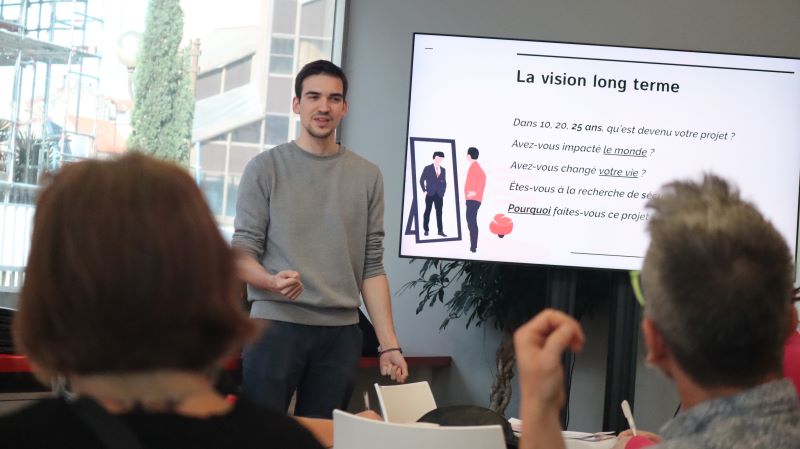
swanbase presentation. Acceleration program for European startups
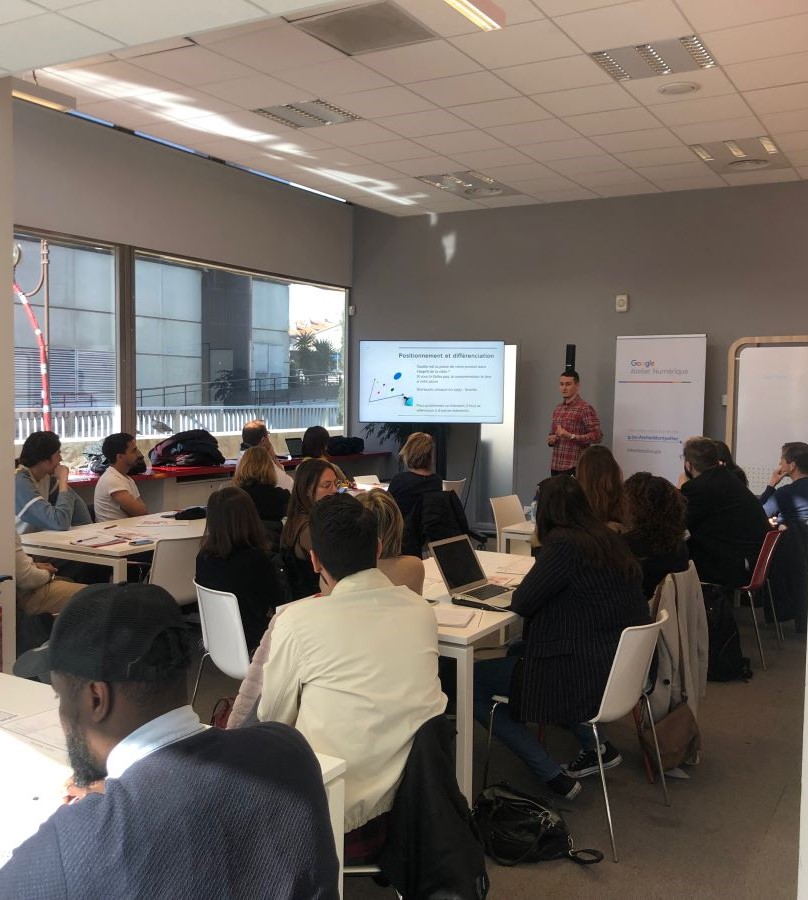
swanbase intervention. Personalized support for entrepreneurs

Joining swanbase:

  • 0€ entry fee. No investment required, 4% equity only if you hit your objectives
  • 100% Remote. Accessible from anywhere in the world
  • No intermediaries. Direct access to experts and mentors
  • Action-focused. Solving concrete problems as they appear

swanbase applies the mechanisms of real innovation. Join a community of entrepreneurs building the future according to the natural rules of the game.

our online resources

Learn how to launch and grow your startup

🎥

Marketing & startup videos

Find our conferences, replays and event recordings. The best advice from French tech entrepreneurs and marketers who have real results to share.

🛠️

Startup & growth tools

We know which tools to use to grow. And we share our best tools with you. Every week you'll find new discoveries to help you acquire customers, create content, raise funds and more.

📝

Blogs, news & essays

Follow French tech and startup news. We share our advice, our discoveries, the successes of our startups and much more. Discover our written formats.

📧

Newsletter & downloadable resources

Receive guides, checklists and downloadable resources in your inbox. We keep you posted on what's new, share advice from French entrepreneurs, and notify you when applications open.