Lovable is revolutionizing application development by enabling creation in just 30 minutes, which is 20 times faster than traditional coding. This exceptional performance has helped the platform raise 6.8 million euros and reach the top spot on Product Hunt.
This nocode solution, powered by artificial intelligence, transforms simple text descriptions into complete web applications. Thanks to an intuitive interface, Lovable AI even allows users without technical skills to build modern sites that integrate advanced features like authentication and online payments.
What's more, the platform has already proven itself with impressive concrete cases, such as building a functional Wordle clone in just two minutes. This complete guide explores Lovable's capabilities, how it works, and how to use it effectively to quickly develop your web projects.
What is Lovable AI and how does it work
Lovable AI represents the culmination of a vision: creating "the last piece of software", a tool capable of generating other software. This platform lets anyone describe an application idea in natural language and obtain a functional product without needing programming skills.
Origin and vision of Lovable
The Lovable story begins in mid-2023 with the creation of GPT-Engineer, an open source project exploring how AI could help build software. This project quickly became the fastest-growing code repository on GitHub, reaching over 50,000 stars. Afterwards, Anton Osika and his team founded Lovable to bring their broader mission to life: democratizing software creation and enabling anyone to turn their ideas into companies.
The name "Lovable" perfectly reflects this ambition to make using and creating software more enjoyable. Since its launch, Lovable has experienced explosive growth, reaching 3.82 million euros in annual recurring revenue in four weeks and 9.54 million euros in just two months.
The principle of development through conversation
Unlike traditional development tools, Lovable works on a "development through conversation" principle. Users simply describe what they want in their native language, and the AI takes care of the rest, generating up to 20 times faster than traditional coding.
With "Chat" mode, Lovable goes beyond simple code generation to become an interactive assistant that guides the user through every phase of development. This conversational development approach not only generates code but also helps users understand programming concepts, experiment, and debug easily.
The technical architecture behind Lovable
On the technical side, Lovable relies on a robust ecosystem. The platform uses React and TypeScript for frontend development and integrates Supabase as a backend service for authentication, PostgreSQL databases, and storage.
The infrastructure also includes GitHub for code storage (with automatic repository synchronization) and Netlify for one-click hosting and deployment. Initially, Lovable was coded in a scripting language, but in response to growing demand, the team had to rewrite the entire codebase in a more performant language, moving from Python to Go to improve performance, scalability, and developer experience.
In addition, one of Lovable's major breakthroughs lies in its ability to "unblock itself", allowing the AI to keep improving and fixing its own bugs.
Discovering Lovable: platform and possibilities
The Lovable platform stands out for its ability to transform text descriptions into functional web applications, delivering a revolutionary development experience for every user profile.
The fundamentals of Lovable dev
At the heart of Lovable is a complete development environment accessible from a simple web browser, with no installation required. The platform combines AI-assisted coding tools, real-time collaboration (currently in beta), and project sharing features within a unified interface.
Among the essential features, you'll find complete application generation from natural language descriptions, smart code suggestions, automatic error detection, debugging assistance, and documentation generation. On top of that, Lovable allows cloud deployment in a few clicks and native database integration.
Types of projects you can build
Lovable's versatility allows you to build a wide variety of projects:
- Product launch pages and showcase sites
- E-commerce platforms and services pages
- Conference sites with integrated ticketing
- Job boards and professional portfolios
- Fundraising platforms and media kits
Lovable also excels at creating more complex applications such as subscription platforms, rental marketplaces with smart search, online auction systems, and mentorship networks with automated matching.
The technical ecosystem (React, Vite, Supabase)
Technically, Lovable relies on React for building flexible and efficient user interfaces, paired with Vite as a build tool that delivers a fast and lightweight development experience.
On the backend side, the platform integrates Supabase, an open-source alternative to Firebase, providing authentication services, data storage via PostgreSQL, and cloud functions. This architecture in particular makes it possible to manage scalable databases that can support millions of rows and high-traffic applications.
GitHub integration makes code management easier, while Supabase edge functions let you add advanced features such as AI, payments, or sending emails.
First steps with Lovable: build your first application
Getting started with Lovable only takes a few simple steps, quickly turning your ideas into working applications without prior technical expertise.
Create an account and understand the interface
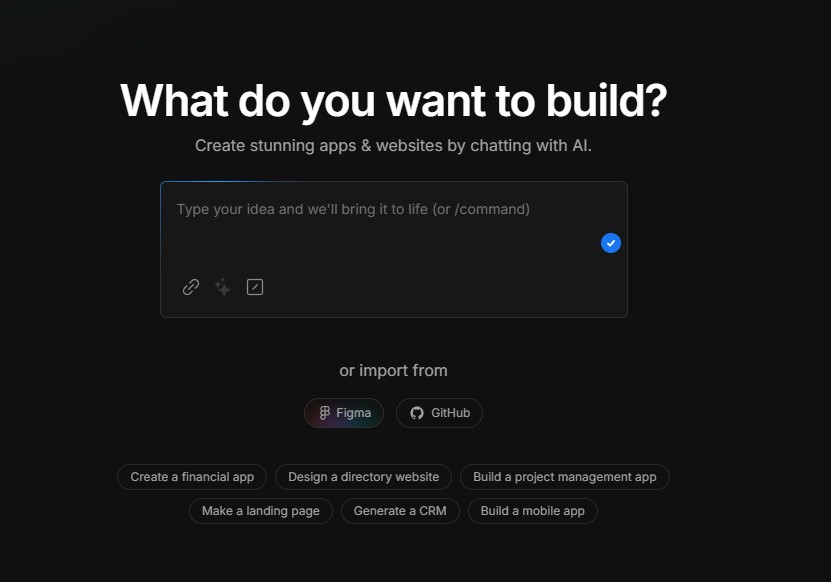
To get started with Lovable, head to lovable.dev and create a free account. Once registered, you'll have access to an intuitive dashboard where you can manage all your projects. The main interface consists of a text input area where you describe your project and editing tools that let you directly modify the generated elements.
Lovable also offers version history and an undo feature, allowing you to experiment without risk. For more technical users, the platform provides synchronization with GitHub to make code management easier in your preferred development environment.
Writing effective prompts
The quality of your prompts directly influences the quality of the generated application. To get the best results, structure your instructions into clear sections:
- Context: describe the overall objective of your application
- Task: specify the desired features
- Guidelines: indicate preferred technologies and visual style
- Constraints: mention any limits or specific requirements
Be precise in your descriptions, avoid vague phrasing, and don't hesitate to break complex projects into several successive prompts. Using examples or visual references can also significantly improve the results.
Connecting Supabase for the database
Supabase integration is essential to add backend features to your application. To set up this connection:
- Click the Supabase button in the top right corner
- Follow the instructions to create a Supabase account if needed
- Authorize Lovable to access your Supabase account
- Create an organization and then a project in Supabase
- Go back to Lovable and select the project you created
It's best to connect Supabase before requesting features that require a database, because Lovable might struggle to generate the appropriate code without an established connection.
Testing and deploying your application
Once your application is built, test it carefully before deploying. Check every feature and make sure they work as expected across different devices.
To deploy, use the "Publish" button located in the top right corner. The process generally takes less than a minute and generates a shareable URL accessible to everyone. You can also use the "Preview" feature to get a temporary link that lets you gather feedback without affecting the published version.
Lovable also offers the option to add a custom domain via Entri, Netlify, Vercel, or Namecheap for a more professional web presence.
Advanced Lovable features for NoCode
Lovable offers several advanced features that transform the nocode development experience, allowing users to build sophisticated applications without specific technical expertise.
User authentication
Authentication is the gateway to any professional application. Lovable significantly simplifies this process by natively integrating with Supabase to manage user logins. This integration lets you quickly implement:
- Secure login and signup forms
- OAuth authentication (login via Google, GitHub)
- Email verification as an additional security measure
Setting this up is done through a simple text description, with no need to manually configure authentication APIs or debug interface inconsistencies. Lovable automatically generates validation logic and error handling, eliminating the need to write custom validation code.
Payment integration with Stripe
To monetize your application, Lovable offers native integration with Stripe. In a few steps, you can set up:
One-time payments or recurring subscriptions directly inside your application. The simplest method is to use Stripe payment links, which let you quickly implement a complete purchase flow.
For more advanced configurations, including webhook and subscription management, Lovable recommends using Supabase and Stripe together. This setup enables secure payment processing and role management based on subscription tiers.
Building installable mobile applications
Although Lovable focuses primarily on web applications, the platform allows you to create Progressive Web Apps (PWAs) that behave like mobile applications. Through a simple instruction to the AI, your web application can be turned into a PWA installable on mobile devices, providing an experience similar to a native application.
Connecting with GitHub for customization
GitHub integration is a major asset for users who want to customize their projects further. This feature lets you:
Automatically sync code to your GitHub repository, making collaboration and version control easier. This two-way synchronization means any change made on GitHub is automatically reflected in Lovable, and vice versa.
In addition, this integration lets you edit the code in your preferred development environment while still benefiting from Lovable's AI assistance.
Lovable vs Bolt: which solution to choose
In the world of AI-assisted development, Lovable and Bolt represent two different approaches to building applications without code. Each has its strengths and weaknesses, which should be analyzed to make an informed choice.
Comparing user interfaces
Lovable's interface stands out with its "Select and Edit" feature, which lets you precisely target elements for modification. This approach offers welcome flexibility for fine-tuned adjustments. Bolt, for its part, provides a development environment integrated directly into the browser, particularly effective for rapid prototyping.
According to user feedback, Bolt's initial designs appear more elegant right from the start, but Lovable excels at adding visual elements like shadow effects. However, Lovable sometimes fails to follow specific instructions about color schemes.
Technical differences and performance
In terms of performance, Bolt generally outpaces Lovable with faster response times: 0.5 to 2 seconds for code generation compared with 1 to 3 seconds for Lovable. Environment startup is also faster on Bolt (1 to 3 seconds) than on Lovable (2 to 5 seconds).
That said, Lovable stands out with its advanced integrations, notably with GitHub and Supabase, which significantly simplifies deploying complex features like databases and authentication. Bolt lacks these integrations but offers a "diff" feature that saves tokens during iterative development.
Pricing and value for money
The two platforms adopt different pricing models:
- Bolt uses a token-based system, offering 10 million tokens for €19.08/month
- Lovable runs on a message-based model, offering 100 messages for €19.08/month
This difference is significant: Bolt's model generally allows more interactions for the same price, while Lovable's can become restrictive for complex projects that require a lot of back-and-forth. Still, Lovable's additional integrations can offset this limitation for professional developers looking for advanced features.
Conclusion
Lovable undoubtedly represents a major step forward in application development. This nocode platform powered by AI radically transforms web application creation, allowing even beginners to turn their ideas into functional products.
The platform's exceptional performance, combined with its robust technical ecosystem and advanced features, fully justifies its dominant position in the market. Its natural conversational interface and its integrations with Supabase, GitHub, and Stripe give users all the tools needed to build professional applications.
Ultimately, although Bolt offers certain advantages in terms of speed and pricing, Lovable stands out for its versatility and its ability to handle complex projects. Developers and entrepreneurs alike can pick the solution best suited to their specific needs, knowing that both platforms will keep evolving and enriching their features.
FAQs
Q1. What is Lovable AI and how does it work? Lovable AI is a nocode platform that uses artificial intelligence to transform text descriptions into complete web applications. It works on the principle of "development through conversation", letting users build applications up to 20 times faster than traditional coding.
Q2. What types of projects can you build with Lovable? Lovable lets you build a wide variety of projects, ranging from showcase sites to e-commerce applications, including subscription platforms, marketplaces, and even online auction systems. The platform suits simple projects just as well as more complex applications.
Q3. How do you get started with Lovable to build your first application? To get started, create an account on lovable.dev, get familiar with the interface, then write a prompt describing your project. Connect Supabase for backend features, test your application, and use the "Publish" button to deploy it. Lovable guides the user through every step of the process.
Q4. What advanced features does Lovable offer? Lovable offers advanced features such as user authentication, payment integration with Stripe, building installable mobile applications (PWA), and connection with GitHub for deeper customization. These features allow you to build sophisticated applications without specific technical expertise.
Q5. How does Lovable compare to other solutions like Bolt? Lovable stands out with its advanced integrations (GitHub, Supabase) and its ability to handle complex projects. While Bolt may be faster and offer better value for money for some users, Lovable excels in flexibility and versatility, especially for developers looking for advanced features.