
MARKETING · Decouple your sales from your time
1. Identify the paying need
You have ten paying customers. It's the hardest thing you'll have to do early on, and it's behind you.
But there's a trap hidden in that win. You know these ten pay. You don't yet know exactly why.
Why this question is less obvious than it looks
When you ask a founder why their customers pay, the answer that comes back almost every time is: "because we solve their problem." On paper, that holds up. In reality, it's too broad to be useful.
The "problem" is a product-side framing. The "need that pays" is a customer-side framing. And the difference isn't cosmetic. It decides what you put on your page, what you write in your posts, who you go after in outbound, and how much you can charge.
Clayton Christensen spent part of his career telling a story about a milkshake. A fast-food chain wanted to sell more milkshakes. It ran focus groups, optimized the recipe, cut the price, added flavors. Nothing moved. They finally observed actual behavior, and they saw that half the milkshakes were bought in the morning, by people alone, in their cars, heading out for a long commute. The milkshake wasn't a dessert. It was a boredom-killer sipped through a straw during forty minutes of traffic, and it filled the stomach until lunch. The competitor wasn't another milkshake. It was the banana eaten in two minutes, or the cereal bar that left crumbs on your fingers.
The milkshake's job wasn't "to be a milkshake." It was to fill an hour on the road, without messing up your hands, while holding off hunger. Once you put it that way, everything changes. The cup size, the thickness, the straw, where the drive-thru line sits. Nothing to do with focus groups anymore.
That's what you're going to do for your product. You're going to find the job your customers hire you for.
Maslow, and why it's rarely enough
There's a pyramid you see everywhere in marketing: Maslow's. Basic needs at the bottom, self-actualization at the top. It's useful for locating a product category, not for deciding on a precise promise.
When you write "our tool helps teams collaborate better," you're at Maslow's "belonging" level. Fine. Except five hundred other tools are in the same spot, so it doesn't set you apart. Maslow gives you a road sign. It doesn't give you the address. You can use it to frame, but you can't stop there.
The need that pays is always more specific than a slot in a pyramid.
The Jobs-to-be-Done grid
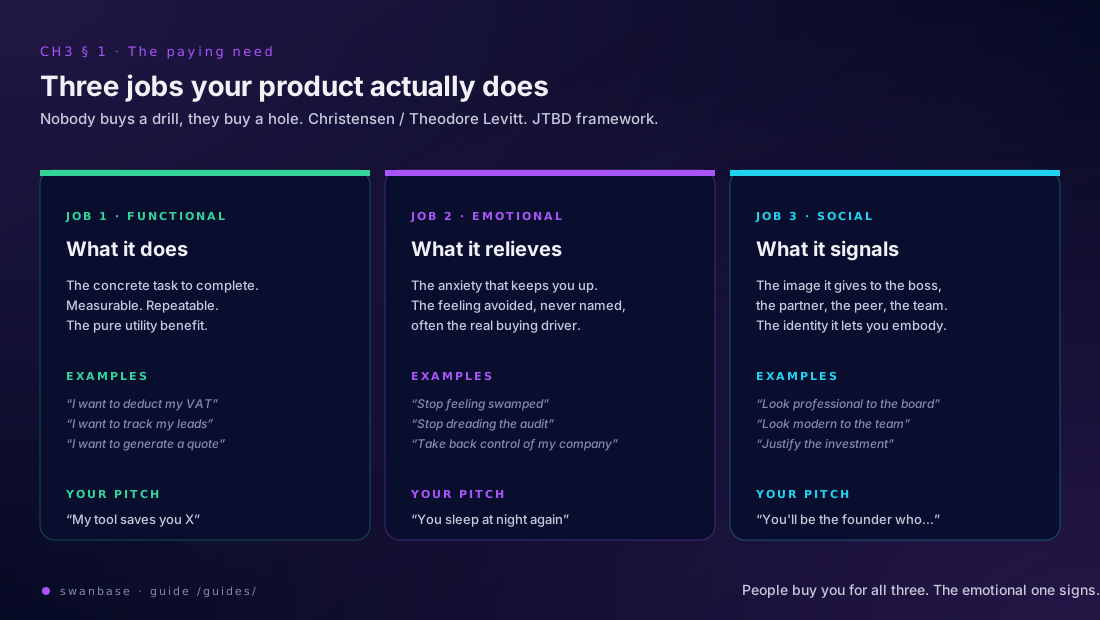
The angle that works is to look at what your product "does instead of." Not what it offers. What it replaces in the person's real life. You're looking for three things, every time.
The functional job. The objective task. "Send an invoice that gets paid fast." "Find a dev available this week." "Ship a ready-to-post video in under an hour." That's what everyone sees first.
The emotional job. What the person feels when the job is done badly, and what they want to feel when it's done well. "Stop being afraid to follow up." "Stop being ashamed of how my site looks." "Feel like I'm on top of the subject." The emotional often decides the final choice, while the functional decides whether it even gets considered.
The social job. What the person wants others to see. "Look like a serious company to my clients." "Be able to show my tool in a pitch without talking it down." "Be seen as someone who's on top of their stack." It's the most private of the three, and often the most powerful on the B2B side.
For a single feature, all three jobs coexist. A Stripe integration, functionally, is "take a card payment." Emotionally, it's "stop stressing about the first sale." Socially, it's "look like a company that knows how to bill." A page that only talks about the functional gives up two-thirds of the conversation.
The "who would do what instead" question
This is the most useful check, and it's the one that hands you your real competitors. You take each of your ten customers and ask: "if we disappeared tomorrow, what would they do instead?"
The answer is almost never "they'd go to our direct competitor." It's almost always more humble. "They'd go back to their Notion plus a separate Excel." "They'd pay a freelancer twenty hours a month." "They'd drop it and live with the problem, like before." "They'd train an intern."
Each answer tells you something. If your real competitors are Excel and a freelancer, your page has to speak to someone who's already getting by with Excel and a freelancer. Not to someone comparing SaaS tools on G2.
It's also what gives you your price. You don't charge against a market benchmark. You charge against the total cost of the alternative the person is using today. If it's a freelancer at a thousand euros a month, you know five hundred euros is a deal. If it's nothing, because they were living with the problem, you have an awareness job to do before you have a pricing job.
The "universal need" trap
At this stage, a lot of founders, afraid of closing a door, write universal promises. "Productivity." "Growth." "Efficiency." These are words with no edge. They please everyone, so they convince no one. Nobody signs a check for "productivity." Someone signs a check for "going from four hours of manual follow-up a week to zero," because the before exists, and the after exists too.
The rule that helps: if you can swap your product's name for a competitor's in your promise and it still holds true, you haven't promised anything.
One sheet per customer, at the end of the section
For each of your ten customers, you fill in the same card, in plain language:
One sheet per customer, the same for all ten
- Customerfirst name / role / company
- Functional jobthe task completed
- Emotional jobthe fear lifted
- Social jobthe signal sent to others
- Alternative if they left us tomorrow
- Cost of the alternativecash or time
After the ten cards, you look for the pattern. Three identical jobs across five different customers, that's your real positioning. An "Excel + freelancer" alternative repeated three times, that's your real competitor. The need that pays isn't invented. It's observed.
Now we move to the second step of this chapter: taking that pattern and tightening the segment further.
2. Tighten your ICP
You've identified a job that pays. Now you're going to do the thing that takes the most courage from an early founder: you're going to exclude people.
Not because you don't like them. Because you can't do everything well for everyone, and at this stage, doing everything halfway means failing everyone.
Why we're afraid to tighten
When you have ten customers, the natural instinct is to chase every extra customer who vaguely resembles the first ten. Widen the net, whatever you do don't cut a branch. The result is a soft promise, a page that speaks to no one in particular, and a sales cycle that stretches with every deal because you adapt each time.
Tightening isn't losing business. It's finding the slice of business that sells itself.
Rahul Vohra, founder of Superhuman, describes in an article that became a classic at First Round Review how he built his product-market fit by doing exactly the opposite of what many founders do. He took Sean Ellis's question, put to his users: "How would you feel if you could no longer use Superhuman tomorrow? Very disappointed, somewhat disappointed, or not disappointed?" He filtered on the "very disappointed," looked at their profile, and tightened the whole product around them. The rest he let go. And only then did the curve take off.
The idea is simple: your best customers have already pointed out who your next best customers are. You just need the courage to look.
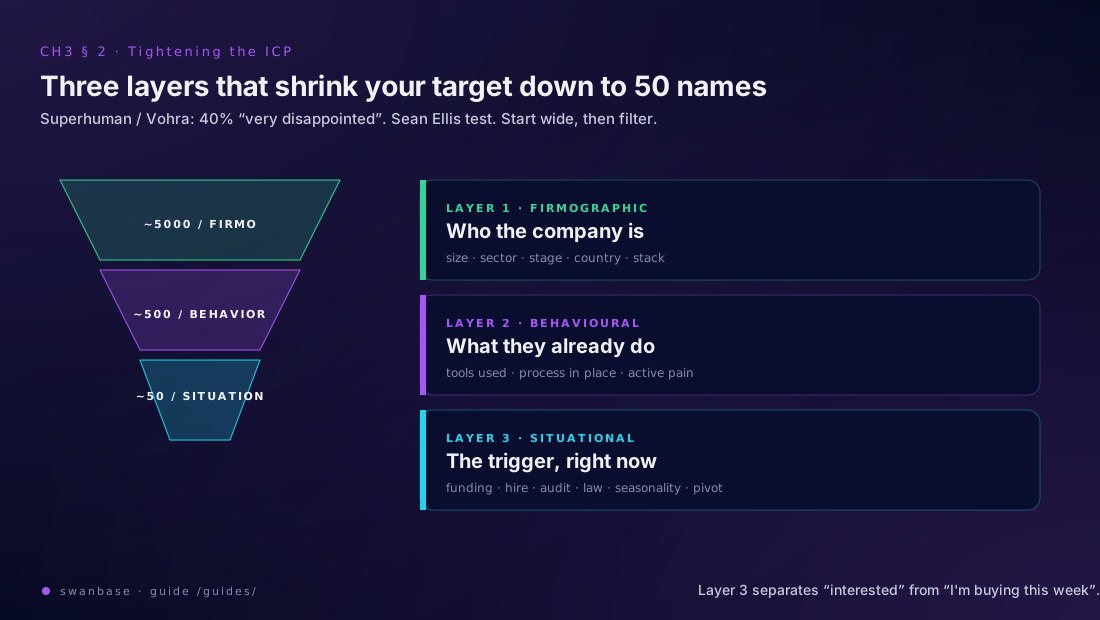
The three layers of a useful ICP
An Ideal Customer Profile (ICP) that's actually useful isn't a persona sheet with a made-up first name and a stock photo. It's a precise description across three layers, and each layer has to stay short.
Layer 1: firmographic. What's visible from the outside. Company size (headcount or revenue), sector, geography, business model, stage of maturity. You're looking for the smallest net that contains your ten current customers. "SMBs" is too broad. "Recruitment agencies, 5 to 15 people, in France, billing on success" is useful.
Layer 2: behavioral. What the company already does, or doesn't. Which tools it uses. Which channels it has tried. How mature it is on your subject. A company that has already tried a competing tool and dropped it isn't the same target as a company that has never looked. An agency that posts twice a month on LinkedIn doesn't have the same posture as one that posts twice a week.
Layer 3: situational. The moment in time. A company that just hired its first salesperson. A team that lost its main tool two months ago. A leader coming back from a training where they heard about this subject for the first time. Timing is often the most overlooked factor, and the most predictive. The same company, the same decision-maker, can be an absolute no in March and an obvious yes in June, because something moved in between.
If your three layers are precise, you can write out a named list of ten to twenty companies that match. Not a marketing segment. A list with real names.
The filtering question
Once your three layers are set, you check with one question, always the same, put to your existing customers: "How would you feel if we disappeared tomorrow?" Very disappointed, somewhat disappointed, not very disappointed.
You look at two things. First, the percentage of "very disappointed." Sean Ellis, who came up with the question, argues that at 40% or more very disappointed, you can talk about a product-market fit signal. That threshold is cited by him, picked up by Vohra and many others, and remains a practical marker more than an absolute truth. You can use it as a compass.
Then, and this is what's truly valuable, you look at who the very disappointed are. Which layers they share. Often you'll discover they're not exactly the companies you were targeting in theory. The segment that loves your product the most isn't always the one you thought you were going after. That's OK. That's actually the point of the exercise.
The self-confirming sub-segment
There's a classic trap when you tighten. You take your three best customers, find a shared attribute ("they're all in Paris"), and decide that's your ICP. Except you have a sample of three, so that attribute could be chance. You'll spend six months recruiting other Parisians and discover geography had nothing to do with the success.
The rule that helps: you look for an attribute that shows up in at least five of your ten customers, and almost never in your "very disappointed" prospects who don't convert. If the attribute is everywhere, it discriminates nothing. If it only shows up in your very best customers, that's a solid clue.
The exercise: your list of fifty companies
Once your ICP is set, you write a list. Not a file of a thousand bought leads. A list of fifty companies you could name one by one, and for each of which you can argue why it matches.
Fifty is arbitrary. It's small enough that you can really look at each line. It's big enough to test whether your ICP is attackable. If you struggle to find twenty companies, your ICP is too narrow or too niche. If you find five hundred effortlessly, it's too broad. You rework your three layers.
Next to each company, you write one sentence: who to contact, and why this person now. Not the generic role, the name and the reason. It's exactly the list you'll use in CH3 section 7 when we tackle systematized outbound.
Your ICP in three layers
An ICP in three layers, one sentence each, and a list of fifty named companies. And at the bottom of the page, one last sentence, written separately:
If we only spoke to this segment for six months
- We'd lose
- We'd gain
If "we'd gain" is bigger than "we'd lose," you have your ICP. Otherwise you rework it.
With a segment set, we can now articulate what we promise these people, and how we prove it.
3. Positioning, Promise, Proof
You have a job that pays. You have a tightened ICP. What's left is to say in three lines what you do, for whom, and why anyone should believe you.
It's that line, in a visible spot, that decides whether the person stays five seconds or five minutes on your page.
Why three lines, not one sentence
Most founders look for the magic sentence. The tagline. Three words that sum up everything. Except summing up everything is mechanically vague. The job of your first lines isn't to be pretty. It's to deliver three independent pieces of information, each answering a different question the person asks on arrival.
First question: "Who is this for, compared to what already exists?" The answer is your positioning.
Second question: "What will change in my life if I listen to you?" The answer is your promise.
Third question: "Why would I believe you?" The answer is your proof.
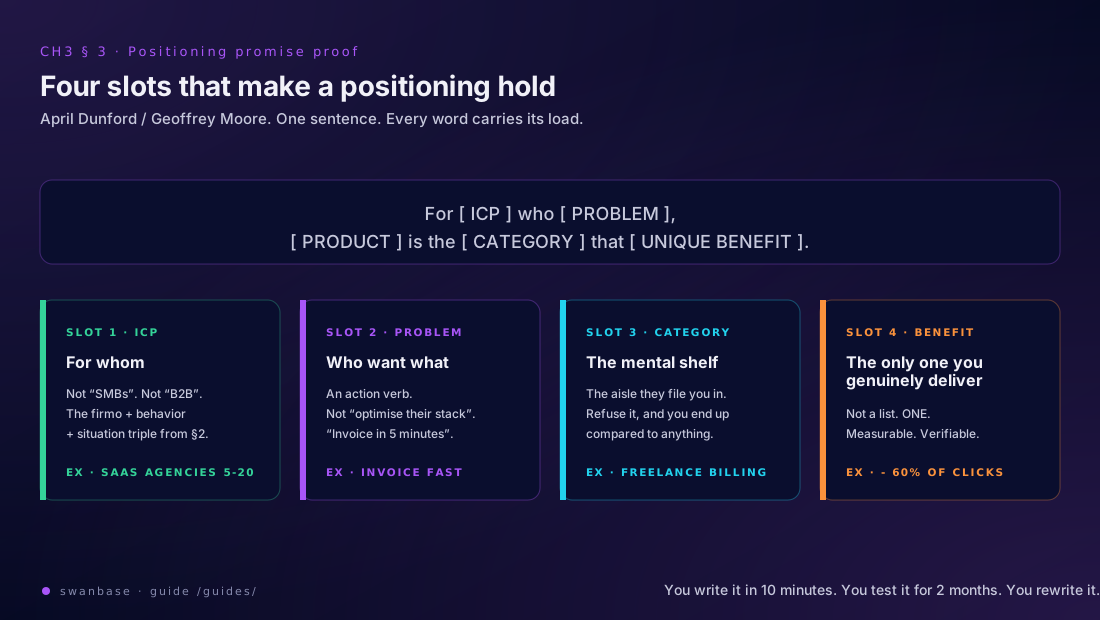
Three questions, three lines. April Dunford, in Obviously Awesome, explains it with a candor you rarely hear: positioning isn't a slogan, it's an act of comparison. You don't have to say you're better than everyone. You have to say which category you belong to, and who you compare yourself to within that category. Otherwise your prospect does it for you, and picks the wrong comparison.
Positioning: what exactly are you compared to
The useful question isn't "what do you do?" It's "you're the alternative to what?"
If you sell an emailing tool for SMBs, you can position yourself as "the simple alternative to Mailchimp for companies under ten people." Or as "the emailing tool built into your CRM, for those tired of juggling two interfaces." Or as "the way to schedule cold emails without becoming a spammer." Three different positionings for the same base feature. Each speaks to a different audience. Each makes a comparison easy and settles it in your favor.
If you don't position yourself, your prospect positions you. Often in the worst possible category. A company that builds an emailing tool with AI and doesn't position itself gets filed by default under "another GPT wrapper." That's not the prospect's mistake. It's the absence of a frame you left them.
A formula that works, borrowed from Geoffrey Moore's Crossing the Chasm framework: "For [your ICP], who [has this specific problem], [your product] is [the category] that [main benefit], unlike [known alternative], [concrete difference]."
It's very long. That's on purpose. You write this sentence internally, not to put on your page. It's there to clarify. Once written, you pull two short versions from it: one for your h1, one for your second line.
The promise: a before, an after, observable
A promise that converts has a simple structure. It says what changes. Not what your product does. What changes in the person's life after they use it.
"An all-in-one emailing platform" describes the product. Nobody sleeps better at night thanks to an all-in-one emailing platform.
"Schedule your Monday campaign in fifteen minutes instead of two hours" describes a before and an after. The person, reading it, can recognize themselves in the before.
You can build a promise in three steps. You take the main job (CH3 section 1). You name the before, meaning what the person does today, in concrete terms (time, money, energy). You name the after, meaning what changes, measurable if possible. If you can put a number, put it. If you can't put a number you can prove, don't put a number. An unprovable promise is a promise that falls flat.
The proof: three forms, never none
This is the line early founders neglect most, because at the start you have little to show. It's also the one that decides trust. Three forms work particularly well.
The customer quote. A short quote, attributed, with role and company. Not anonymous, ever. An anonymous quote is worth zero. A quote with a name and a real photo is worth a lot. If you have permission, you can add a link to the person's LinkedIn profile. The quote becomes a verifiable signal.
The verifiable number. "Three hundred campaigns sent through Company X this year." "Four hours saved per week on average, measured across fifteen customers in 2025." You don't say "boosts your productivity by 300%" if you don't have the data behind it. You say what you know.
Proof by demonstration. A GIF, a real screenshot of your tool, a visual before-and-after. Not a stylized Figma mockup. A raw screenshot. It's less pretty. It's more credible.
You don't need all three. You need at least one. A page with no proof, at this stage, doesn't convert. It just convinces people already decided to buy.
The worn-out promise
The big trap at this stage is using words that belong to everyone. "Productivity." "Growth." "Performance." "All-in-one." "Effortless." These words are so worn they no longer register. They're not promises, they're signals that you didn't take the time to write.
The rule that helps, again: if you can swap your product's name for a competitor's in your promise and it still holds true, you haven't promised anything. You change the sentence until it no longer works for the competitor.
The exercise, in three lines
On a sheet, by hand, you write:
Three lines, by hand
- Positioningfor… unlike… we are…
- Promisebefore… after…
- Proofa number or a case
You read the three lines aloud, to someone who doesn't know your product. You ask them what they understood. If they repeat roughly your sentence, you're good. If they say "so it's a tool that helps with productivity," you start over.
You redo the exercise every week for a month. The right version never shows up on the first draft.
Your three lines of positioning
Three lines, validated by five different people outside the team, who repeat roughly the same thing after reading them. And these three lines, we put them back in the right order, on the right page, in the next section.
4. The sales page
You have three lines. Positioning, promise, proof. That's the hard core. Now you're going to turn it into a page someone can read top to bottom and end up clicking.
A page that sells isn't a page that describes your product. It's a page that answers, in order, the questions your visitor is asking.
The two uses wrongly assigned to it
A page that sells isn't a brochure. A brochure lists what the product does. Nobody but you wants to read that. When someone lands on your page, they're not wondering "what does this product do?" They're wondering "can I trust you to solve my problem?" The whole page has to answer that question, in the right order.
The right order isn't intuition. It follows the logical sequence of a human brain meeting a new solution. And that order you respect, even if you think it isn't pretty.
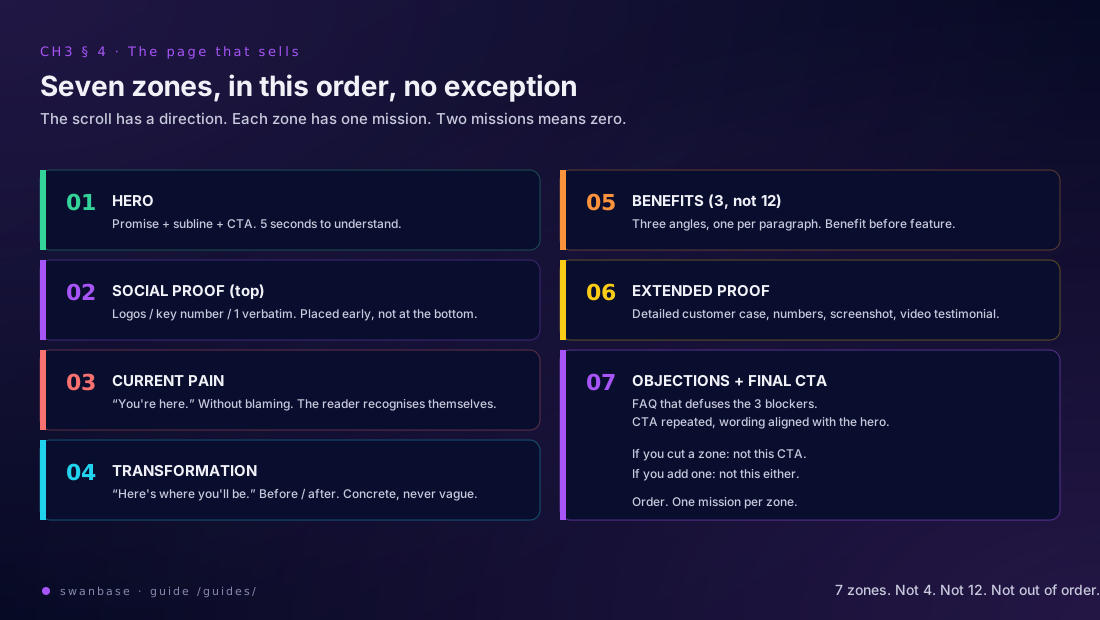
The seven zones of an effective page
You can vary the design. You can't really vary the order of the information.
1. The hero (above the fold). Three elements: an h1 that states the promise, a subline that states the positioning (for whom, against what), a visual that shows the product in action. Not an ultra-stylized mockup. A raw screenshot, or a fifteen-second video. The visitor has to understand in five seconds: this is for me, it does this, and it looks like this.
2. High social proof. Right under the hero, before any talk about the product. Customer logos (real ones), a customer quote with photo and name, or a key number you can genuinely back up. No "joined by 10,000 companies" without a list. High proof defuses the question "has anyone else tried this before me?"
3. The recognized pain. A block that describes the before. Not in vague words. In words your ICP uses. "You spend two hours a week retyping candidates." Not "you waste time." The visitor has to be able to mentally check: "yes, that's me, that's exactly it." The best source for writing this section is the verbatim from interviews and concierge onboardings. You reuse their words.
4. The transformation. You say, at a high level, how your product moves someone from the before to the after. Three steps maximum. Not twenty features. Three simple, visual, sequential steps. This is the moment to add sub-screenshots to show each step.
5. The concrete benefits. Three to five blocks, each with a short title (a benefit, not a feature) and one line of detail. A benefit is what the person gains. A feature is what you build. "Schedule your campaign in fifteen minutes" is a benefit. "Drag-and-drop builder" is a feature. If you're unsure, ask yourself: does it end with "...so the person can ..."? If yes, it's a benefit. If not, it's a feature.
6. Extended proof. A second dose of proof, richer than the one at the start. A short case study with a specific customer. Three testimonials with photos. A strong, verifiable number. At this point in the page, the person is interested. They need arguments to bring to their team or themselves to justify the decision.
7. Objection handling + call to action. You take the three most frequent objections you've heard in onboardings and sales conversations. You answer them FAQ-style, short and direct. "Does it work if we're on our own? Yes, here's how." "What's the price? Starting at X, here's the breakdown." "How long to get started? Fifteen minutes, here's the first step." And right after, the main call to action. A single button. Not three.
One call, everywhere
Your main button has to do the same thing everywhere on the page. If at the top it says "Book a demo" and at the bottom "Start for free," you lose some visitors to the confusion. You pick one call, based on your model. For most early B2B, it's either "Book fifteen minutes" (sales-led) or "Try it free with your work email" (PLG). You put a single version, and you repeat it.
If you're unsure, take the less demanding of the two. At this stage, you want pipeline fill. Not pre-commitment sorting.
The five-second test
Once your page is written, you run a simple test. You show it to five people, outside the team, who know nothing about your product. You give them five seconds to scroll the top of the page. You close the window. You ask them:
- Who is it for?
- What does it do?
- Why would it be useful?
If three out of five answer roughly right, you're good. If most hesitate or get it wrong, your hero doesn't hold. You rework that part, not the rest of the page.
The tool to put it online
You don't need a dev. Several tools let you publish a clean page in a few hours, no code:
- Framer (framer.com): very good output, clean animations, CMS if you want to add a blog later.
- Webflow (webflow.com): the market standard on the no-code side, more technical flexibility.
- Carrd (carrd.co): ultra-minimalist, enough for a genuine first version.
You can assist the first version with v0 (v0.dev) or Lovable (lovable.dev) to generate a skeleton from a prompt. You'll have to rework it afterward. But you start in hours.
The criterion, as always, is speed to publish, not final polish. A page published in three days and improved three times a week beats a perfect page published in two months.
The pretty page
Polish soaks up all your time. You'll be tempted to fuss over the typography, the spacing, the animations. None of those details make someone buy who wasn't already buying. Content decides. You put eighty percent of your time on writing and proof, twenty percent on design. You can always come back and beautify later.
Your page online, tested
A live page, structured in seven zones, with a single call to action, and a five-second test passed by three out of five people. And in a corner of your file, a mini-checklist:
Your page checklist
- Hero understood in 5 secondsyes / no
- Social proof placed up topyes / no
- Pain written in the ICP's wordsyes / no
- Transformation in 3 stepsyes / no
- Benefits before featuresyes / no
- Customer case with a numberyes / no
- Objections handled and a single CTAyes / no
If a box is no, you go back. If everything is yes, we tackle the psychology that makes this page convert better than another.
5. Influence and persuasion on your page
You have a clean page. You want it to convert better than it does today.
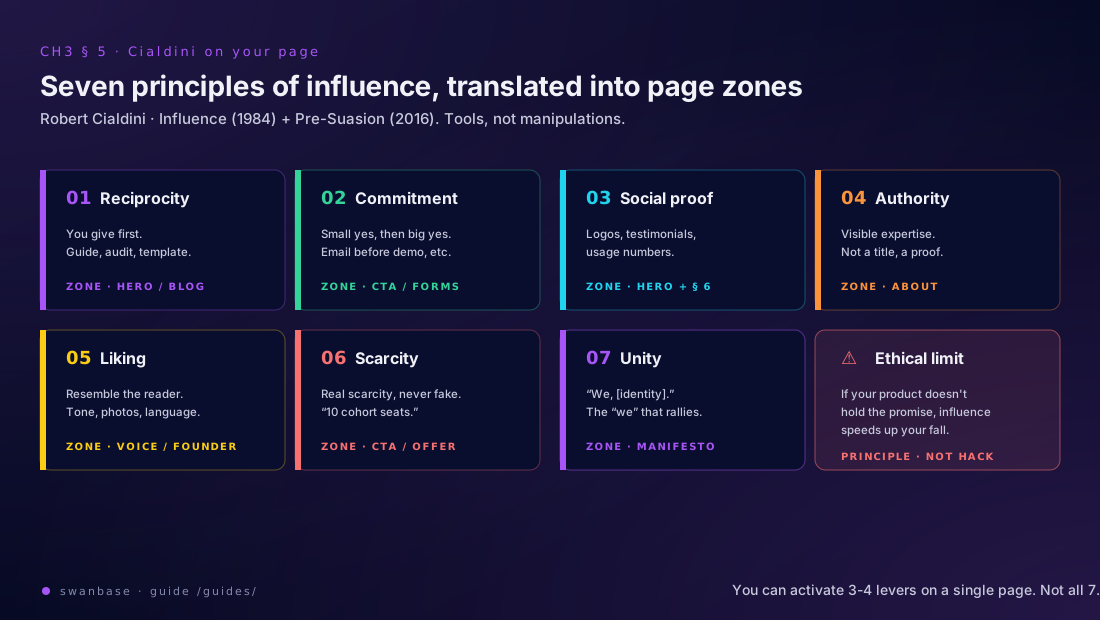
The mistake at this stage is believing it comes down to design or the button. It comes down to seven psychological levers Cialdini spent his career documenting, and that work as well on a web page as in door-to-door selling.
Why a psychologist is talking about marketing
Robert Cialdini, a professor at Arizona State, did something few researchers do. For three years he went undercover in sales schools, fundraising outfits, telemarketing floors, cult recruitment, watching what actually worked. What he found fits into seven principles, which he published in Influence in 1984. Six at first, a seventh added in 2016 in Pre-Suasion.
These seven principles describe mental shortcuts our brains use to decide fast, without analyzing everything. Understanding these shortcuts gives you two things: recognizing when someone tries to turn them against you, and using them cleanly when you build something that deserves the purchase.
It's not manipulation if what you sell deserves the purchase. It's manipulation if what you sell isn't worth it. The line is ethical.
The seven principles, translated for a web page
1. Reciprocity. Humans feel obliged to return what's given to them first. Give something useful and free before asking for a payment. A mini-tool, a downloadable checklist, a fifteen-minute audit, a precise video that answers a concrete question. Not a forty-page ebook nobody will read. Something small, useful, and consumed in five minutes.
2. Commitment and consistency. Once someone has said yes to something small, they're more inclined to say yes to something bigger. On your page, that means a "Start with X" button is almost always more effective than a "Buy now" button. You move the person up one notch. Not ten.
3. Social proof. When we hesitate, we look at what others do. That's why customer reviews, logos, and usage numbers convert so well. On your page, social proof rests on being verifiable. An anonymous or fabricated quote is felt from miles away, and has the opposite effect. A quote with a photo, a name and a LinkedIn link tips a decision.
4. Liking. We buy more readily from people we like. Liking comes from the person behind the product being visible, human, taking a stance, telling you what they think. That's why, on a founder-led product page, putting a photo and a word from the founder at the bottom raises trust. Not a stock photo. Your photo, your name, and three lines written in your own words.
5. Authority. We more easily follow someone we perceive as competent in their field. Authority, on your page, is built through verifiable signals. Logos of known companies that trusted you. Public articles where you're cited. Degrees or relevant background if you choose to show them. No self-declared "recognized expert." You show proof, you don't claim to be one.
6. Scarcity. What's rare has more perceived value. Careful, this is the principle most easily used in bad faith. Scarcity has to be real. A cohort limited to fifteen spots, because you support people by hand, is rare. "Only 3 spots left" on a fake counter is fake, and it shows. If you use scarcity, it has to be verifiable and limited for a concrete reason.
7. Unity. The most recent, added in 2016. We more readily follow people who are like us, who belong to our group, who share our identity. On your page, unity is built through the vocabulary you use (your ICP's words), the cultural references you make, the stances you take. A tool for developers that uses the dev community's words, and takes a clear stance on the technical topics of the moment, activates unity far more effectively than a "professional" tool speaking corporate jargon.
The double-lever rule
A good page doesn't use all seven principles at once. It uses two or three, well activated. The seven principles aren't a checklist to tick, but a menu where you pick the ones that match what you sell and who you sell to.
For a product where the decision is quick and the risk low (a tool at ten euros a month), you mainly activate reciprocity (free trial, free mini-tool) and social proof (logos, testimonials). Authority and unity matter less, because the person won't run a long investigation before deciding.
For a product where the risk is high (a tool at a thousand euros a month for a team), you mainly activate authority (proof of seriousness, founder-led content) and unity (your segment's clear vocabulary and stances). Reciprocity exists but isn't enough on its own.
It's up to you to choose, based on your ICP and your price.
Dark patterns
All these principles can be used dishonestly. Fake counters, fake quotes, fake logos, fake ghostwritten founder-led content. It works short-term. It backfires long-term. Once a company is tagged as "the one that puts fake things on its page," it's very slow to recover.
The useful rule: you only use a principle if you can stand behind, under oath, what you put. You don't have ten thousand users? You don't write it. You don't have thirty customers in your segment? You don't put the logo. You can tell people you're at the start. You can say "first cohort." The truth, said with confidence, converts better than a well-marketed lie.
Your page checklist
A checklist, in your page file:
The seven principles, reread on your page
- Reciprocity a free giftpresent / absent
- Commitment a small step before the big onepresent / absent
- Social proof verifiablepresent / absent
- Liking visible founderpresent / absent
- Authority proof to back itpresent / absent
- Scarcity real, otherwise zeropresent / absent
- Unity the ICP's vocabularypresent / absent
You aim for two or three well-activated "present," rather than seven lukewarm ones. Once set, we move to the thing that will fill your page with warm traffic: your own content, written by you.
6. Founder-led content
You have a page that can convert. Now you have to bring people to it. The cheapest path, and the slowest to set up, is to write yourself, in your own name, on the subjects you know better than others.
This isn't communication. It's distribution.
Why it has to be you, not an agency
There are three reasons, and they're all tied to where you are right now.
First, at this stage, you don't have the budget to buy attention. The cost per lead on B2B ads in saturated markets has risen steadily since 2020. You can try, but you won't get a viable return for a long time. Founder-led content, on the other hand, has no purchase cost. It has an effort cost. And the effort, at this stage, you have.
Next, your first buyers buy your person as much as your product. At ten customers, at fifty customers, at two hundred customers, people want to know who's behind it. They want to check that you think correctly, that you take a stance, that you know what you're talking about. A company with no human face doesn't have the same credibility as a company where the founder publishes. It's not a fad. It's what early B2B has always been. Founder-led content is just the internet version.
Finally, and this is what nobody tells you, writing changes what you build. You're forced to put words on your intuitions. You get reactions that tell you what people don't understand, or what annoys them. You calibrate your positioning in public. Six months of regular publishing move you forward more than a year of solitary thinking.
The three post archetypes
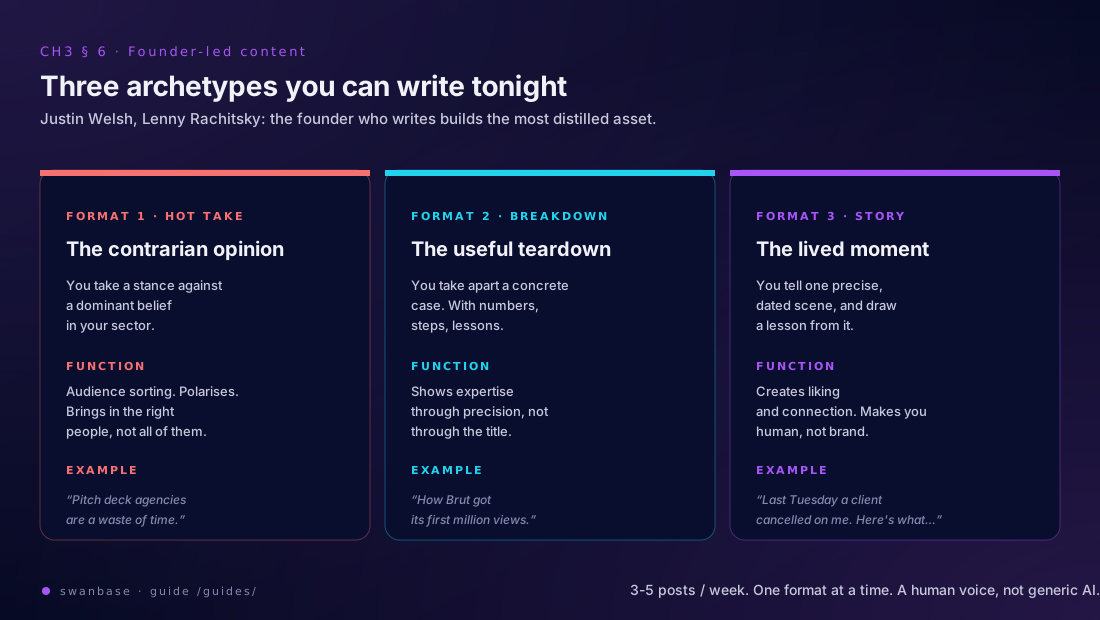
You can vary the style. You can't really vary the angles. Three work particularly well on LinkedIn and X, and they're the only ones you need to start.
The hot take. A contrarian stance, written with confidence, on a subject your ICP has an opinion about. "Stop posting ChatGPT content, it undermines your credibility." "SEO is dead, not for the reasons you think." "Selling via LinkedIn DM still works in 2026, here's why." The hot take rallies those who agree, and annoys those who don't. Both groups engage, and the algorithm rewards you for the conversation.
The breakdown. A detailed, clear explanation of something you do better than the average of your target. "How I close 1 deal in 4 with B2B cold email, step by step." "How I migrated our whole analytics stack in two weeks." "The discovery call template we use, and why we cut the 'what's your budget' question at the start." The breakdown positions you as someone who knows, and it converts into long-term follows, because people know they'll get more breakdowns later.
The story. A short personal account, with a clear lesson at the end. "The worst pitch I saw this week, and why the founder still closed his deal." "The mistake I made with my first customer that cost me 8,000 euros." "The moment I realized our positioning didn't hold, watching three prospects in a row drop off at the same spot." Storytelling works because it makes the lesson memorable, and because it makes you human. Nobody remembers a list of tips. Everyone remembers a story.
You can stick to these three angles for six months without burning out and without running short of material. You do one hot take a week, one breakdown a week, one story a week. You adjust based on what works.
The sustainable cadence
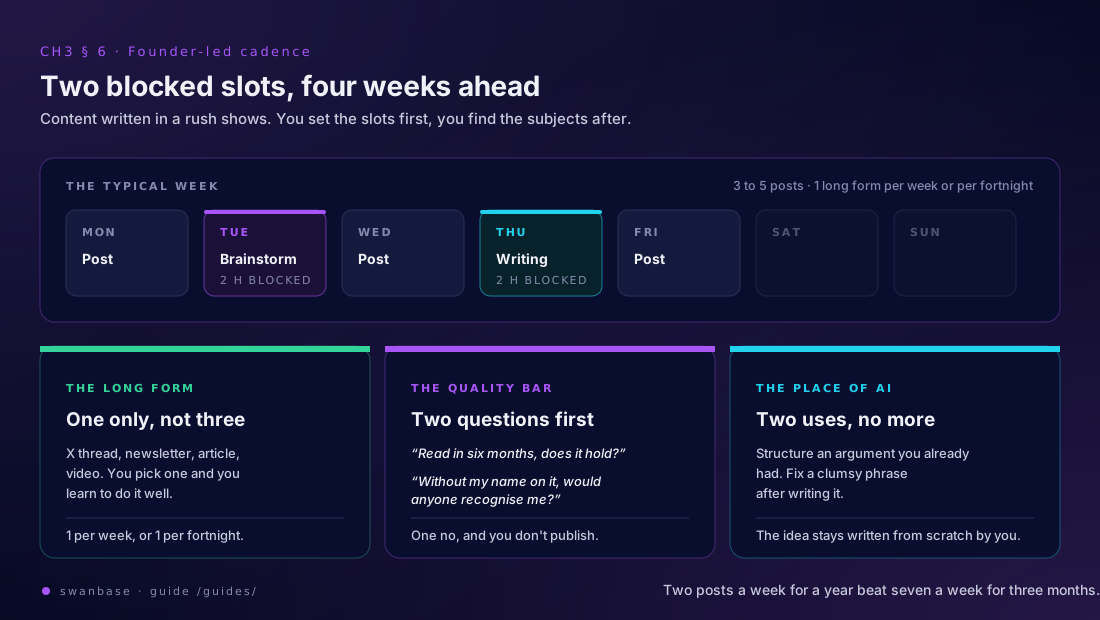
The rule that holds over time is three to five posts a week on LinkedIn, and one long-form piece once a week or every two weeks. The long form can be an X thread, a Substack newsletter, an article on your blog, a video. Pick one only. You learn to do it well before spreading yourself thin.
You set two fixed slots in your week, one for brainstorming, the other for writing. Two hours each. You don't do this squeezed between two meetings. Content written in a rush shows, and it's exactly the content that doesn't work.
You publish at the pace that holds, not the pace that flatters you at the start. Better two posts a week for a year than seven a week for three months followed by zero.
The quality bar
The useful question to ask yourself before each post: "Would I be OK with this post being read in six months?" If the answer is no, don't publish. If it's a hot comment on the news, OK for a like or two, and forgotten within the week. If it's a stance you defend or a breakdown you give, it has to hold up over time.
The other useful question: "Did I really write it, or is it a generic thing fifty other accounts could publish?" Successful founder-led content has a voice. That voice comes from what you put of yourself: your anecdotes, your stances, your way of telling a story. If you remove your name and no one recognizes you anymore, you said nothing.
AI content
You'll be tempted to generate five posts a day with an LLM. You might get likes at first. You'll lose your audience in the medium term, because generic AI content has become recognizable, and it ends up undermining the credibility of the account posting it.
AI is useful for two things, and only two. To help you structure an argument you had (you give it your notes, it proposes an outline). To help you fix a clumsy phrasing after writing (you give it the text, you ask it for three clearer variants). The rest stays with you: you write each idea yourself from scratch. This line you respect, otherwise you build an audience that won't follow you when you sell.
Your editorial calendar
An editorial calendar, four weeks ahead, with one subject per day, and a format identified (hot take / breakdown / story). You don't need a sophisticated tool. A Google Doc with a four-week grid is plenty. And at the bottom of the document, a mini-checklist:
The cadence, at the bottom of the document
- 3 to 5 LinkedIn posts planned this weekyes / no
- 1 long-form piece per week or per fortnightyes / no
- A personal voice on every textyes / no
- Subject still valid when reread at 6 monthsyes / no
- 2 writing slots blocked in the weekyes / no
When that holds over four weeks, we move to the other half of distribution: systematized outbound, which doesn't depend on a platform's algorithm.
7. Systematized outbound: the other half
In CH2 section 5, you sent a hundred cold DMs by hand. In section 6 of this chapter, you built a voice that brings you inbound. These are the two halves of the same problem: filling a pipeline that doesn't depend only on your old contacts. Section 6 brings in people who already know you exist. Section 7 goes after those who don't. And the difference from CH2 section 5 is that you no longer do it by hand once, you build a system that runs every week.
"I send a thousand emails and see what happens"
Before describing what to do, let's set what not to do. As soon as you discover the tools, you'll be tempted to scrape a list of five thousand contacts, write a template, and hit send. You'll get three replies, ten unsubscribes, and a domain that will never deliver your emails properly again, because the spam filters will have classified your sender as noise.
This isn't a theoretical scenario. It's what happens to most founders who discover automated sequences without a framework. The cost of a burned domain isn't "I'll have to change my email address": it's six months of repair, or a new domain name for good. You pay dearly for nothing.
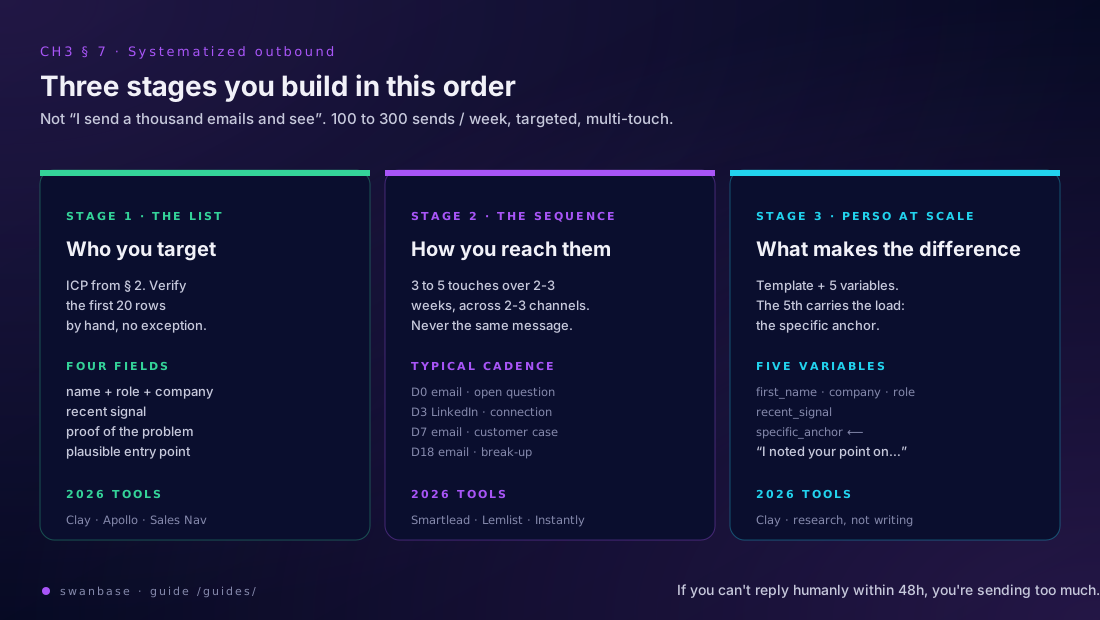
Systematized outbound isn't "send more," it's "send better to more people." The difference is in three stages.
Stage 1: the list
An outbound list isn't a LinkedIn Sales Navigator dump with three filters and five thousand rows. It's a list of targets that match your ICP from section 2, verified by hand on the first twenty rows, and enriched with enough signal to personalize without inventing.
Concretely, next to each row you write four fields:
Four fields per list row
- Name, company, role
- Recent signalfunding, hire, post, product launch
- Proof this person has the problem
- Plausible entry pointrelationship, event, shared content
If you can't fill these four fields for someone, that row shouldn't be in your list. You can be wrong, but not in front of five thousand names at once. The cost of bad targeting at scale is your sender. The cost of good targeting at scale is revenue.
The 2026 tools that help at this stage are Clay (data enrichment, scoring), Apollo (B2B contact database), and Sales Navigator for initial sourcing. None of them saves you from manually verifying the first twenty rows.
Stage 2: the sequence
A modern outbound sequence runs three to five touchpoints spread over two to three weeks, across two or three channels (email, LinkedIn, even phone if you can). The first touch opens a door, the following ones keep it open without becoming harassing. You never send the same recycled message.
The reference structure in 2026 looks like this:
| Day | Channel | The message |
|---|---|---|
| D0 | Personalized signal and open question, no pitch | |
| D3 | Connection with no note, or a very short note | |
| D7 | Reframe and one customer case in a sentence | |
| D12 | Useful comment on one of their posts | |
| D18 | Break-up: I won't push, here's the link just in case |
You don't ask for a meeting at D0. You ask a question that can be answered in two sentences. You don't attach a fifteen-slide PDF. You don't send a Calendly before they've replied once. And you write each message as if you were sending it to a single person, because for the person receiving it, that's exactly the case.
The 2026 tools that run this without breaking your domain are Smartlead, Lemlist, and Instantly. They handle address warm-up, distributed sending, and the automatic pause if someone replies. What they don't do is write for you. If you let their AI copywriting write by default, you fall right back into the trap from the start.
Stage 3: personalization at scale
This is the stage that stumps most founders. You can't write a thousand personalized emails by hand. But you can write a template that contains five personalized variables, and that once filled in, gives a message that sounds written for the precise person receiving it.
The five variables to fill for each row:
The five template variables
- first_name
- company
- role
- recent_signal"I saw that you raised / hired / published X"
- specific_anchorthe detail a generic template would never have
The fifth field is the one that makes the difference. It's the sentence that couldn't be in another email. "I noted your point on Y in your podcast from March 12" is an anchor. "I saw you work in tech" isn't. The first takes five minutes per row. The second takes three seconds and it shows.
This is where enrichment tools like Clay become useful: they can automate collecting the signal (latest post, latest funding, latest event), but you're the one who chooses which signal is worth citing, and how. You don't outsource the writing, you outsource the research.
The legal framework we're not allowed to ignore
You prospect in France, in B2B, and you're probably targeting contacts in Europe. GDPR and the CNIL framework on B2B prospecting are clear on two points: you can contact a professional at their work address for an offer related to their role (legitimate interest), provided you offer a clear and immediate opt-out in every message. [to source: CNIL B2B prospecting reference, latest version]
Concretely, at the end of each email, a line like "if this subject isn't relevant to you, let me know and I'll stop reaching out" is enough, as long as you honor the request. No automated unsubscribe that never works, no tracking without notice. This framework is also your sender reputation. European email providers (Outlook, Gmail Workspace, Proton) quickly downgrade a domain that generates too many complaints.
The weekly measurement loop
Once the sequence is running, you measure four things each week. Not twenty. Four.
Four numbers, every week
- Emails sent
- Replies receivedany kind
- Meetings booked
- Deals signed
You look at the ratios, not the absolute numbers. If you send three hundred emails for zero replies, you have a targeting or first-touch problem. If you get replies but no meetings, it's a sequence or proposition problem. If you get meetings but zero deals, back to the page that sells from section 4 and the pitch from section 3.
No optimization makes sense below fifty sends a week. With less volume, you confuse noise with signal. Above three hundred a week at early-stage, you leave founder-led behind and start industrializing for the sake of it. Stay in the range of a hundred to three hundred until you've hired.
The anti-pattern that costs six months of repair
You'll see tutorials promising you "ten thousand emails a week with fifteen warmed-up addresses." These tutorials exist, these setups work technically, and they're built for players who sell volume against volume. You're not in that category. You sell an offer to specific humans who could pay ten times more than a mass product.
The simple rule: if you don't have the capacity to reply humanly to a response, you're sending too much. You measure that capacity by looking at last week's unread replies. If you have more than five sitting there, you lower the volume until you can handle each reply in under forty-eight hours. It's a simple guardrail, and it's the one that makes the difference between an outbound that brings in and an outbound that burns.
Your outbound, set down on one page
Your outbound, written down in black and white
- Target ICPrecall of section 2
- Current listrows verified by hand
- Sequence in placenumber of touches, channels
- Selected toolssending, enrichment
- Target weekly volumebetween 100 and 300
- Fifth template variablethe specific anchor
The two guardrails
- Opt-out mention at the bottom of every emailyes / no
- Capacity to reply humanly within 48hyes / no
When you can tick all of that, your outbound runs. You no longer depend on anyone but yourself to fill the pipeline. And you have a system.
The transition to CH4
At this stage, you have a product that solves a precise need for a tight ICP, a page that sells while you sleep, a founder voice that brings in inbound, and an outbound that runs without burning you out. You've decoupled your sales from your time. You're no longer in the direct conversation for every deal.
CH4 will ask you a different question. What you've built so far is a pipeline that works, but it's still a collection of tactics. CH4 teaches you to compose these tactics into a self-feeding growth machine. When inbound feeds outbound, when customers become channels, when this week's content unlocks next month's sequence. It's a different craft, and it's the one that separates a startup that grows from a startup that stalls at thirty customers for two years.
Before you turn the page, take an hour to write out flat what's already working for you in CH3, what isn't working yet, and what you haven't tried yet. This page will be your entry card into CH4.
See you at the start of CH4.
CH3 . Your page sells and your channel repeats without you
You're no longer "convincing by hand." You have a page that strangers read top to bottom and end up clicking. You have one or two content formats you produce each week, and an outbound that runs without you replaying it on every send.
You haven't hired. You haven't raised. You've just stopped being the only salesperson in the room.
The end-of-chapter artifact
By the end of this chapter, you should have:
- An ICP in three layers: firmographics, behavior, trigger. You can name the 50 companies (or people) you want to reach this season.
- A positioning in four slots: product, category, unique benefit, audience. One sentence. Tested for two months.
- A page that sells, seven zones, one main CTA, a scroll that carries from before to after.
- Three to four Cialdini levers activated on the page, without putting all seven (no manipulation, tools instead).
- A founder-led content format (hot take, useful breakdown, or lived story) published 3 to 5 times a week.
- A systematized outbound: qualified list, 4-8 touch sequence, five-variable template. 100 to 300 sends a week, targeted.
When you can step away for two weeks and the leads keep coming, you're ready for CH4.
The playbook copied from LinkedIn
You'll be tempted to copy playbooks seen on LinkedIn or Twitter. A Linear page, a Lenny newsletter, an Aaron Ross cold email. The problem lies in how poorly they fit your ICP. You'll spend six weeks on a format that brings in nothing because it was designed for another stage, another audience, another price.
The signal that you're ready for CH4: three distinct channels each bring in at least one customer a week, without you hands-on, and you start to see cumulative effects (content pushes outbound, outbound feeds the page, the page converts better because the leads are better qualified).
On to CH4
You'll stop manufacturing revenue and start building the machine that produces it. The intention shifts one last time: you're no longer looking for customers, you're looking for the engine. You'll set your North Star Metric, your Growth Model, and identify the bottleneck that decides your next twelve months. You'll put in place the weekly ritual (Flywheel) and test your first loops.
The move from CH3 to CH4 is the move from "founder-led marketing" to "founder-led growth strategy." You still decide, but you decide in system, not in intuition.