With an impressive 80% success rate in data enrichment, Dropcontact quickly established itself as a major player in the market, particularly when it comes to pricing and features. Founded in 2018, this younger company goes head to head with FullContact, a veteran that has been in the B2B data enrichment space since 2010.
The two platforms take different approaches. Dropcontact's pricing starts at €24 per month for 1,000 credits, while FullContact bets on a broader range of enrichment services. This in-depth comparison analyzes their respective features, pricing structures, and effectiveness in verifying professional data.
Comparing the core features of Dropcontact and FullEnrich
The features offered by Dropcontact and FullEnrich show notable differences that reflect their distinct approaches to B2B data enrichment.
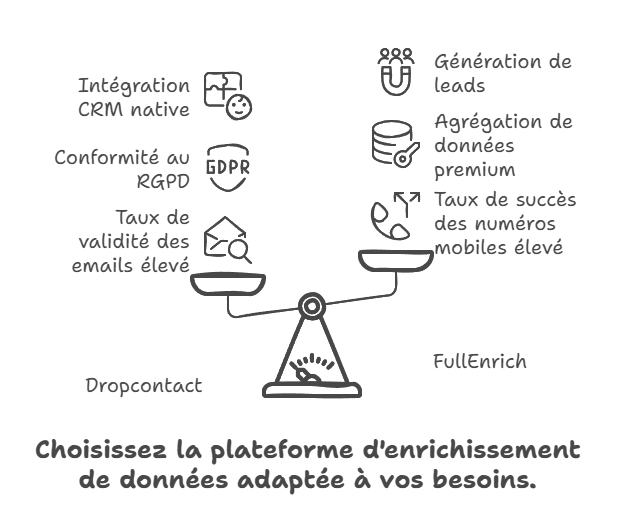
Dropcontact stands out primarily through its proprietary algorithms that generate information in real time. This technology reaches an impressive 98% email address validity rate and 85% for catch-all emails. The tool relies on no name-based database, which makes it the only enrichment solution that is 100% GDPR compliant.
Dropcontact's flagship features include:
- Finding and verifying professional emails
- Enriching and cleaning data
- Automatically detecting and merging duplicates
- Standardizing data (correcting swapped first/last names, adding capitalization)
- Retrieving email signatures to complete contact records
FullEnrich, on the other hand, focuses more on lead generation. Its strength lies in its ability to aggregate contact details from more than 15 premium providers. This approach lets it reach a success rate above 85% on mobile numbers, making it a particularly effective tool for prospecting teams that favor phone outreach.
When it comes to integration, Dropcontact connects natively with several popular CRMs such as Pipedrive, HubSpot, and Salesforce, allowing you to automatically enrich, verify, and clean your contact databases. The tool also offers a robust API for custom integrations.
On duplicate management, Dropcontact provides an advanced feature that automatically detects and merges duplicates without losing information, even when a contact's properties differ from one record to another. This capability is especially useful for keeping databases clean and up to date.
So while both platforms offer data enrichment services, their respective specialties make them complementary depending on each user's specific B2B prospecting needs.
A detailed look at pricing and subscription plans
The pricing structures of Dropcontact and FullEnrich reflect their different approaches to data enrichment, each offering a credit-based model but with important nuances.
Dropcontact offers a base plan starting at €24 per month for 1,000 credits, with a simple principle: 1 credit equals 1 email found. In this system, a credit corresponds to a request run by the algorithm, regardless of the information returned. One notable advantage is that if no email is found, the credit is automatically refunded. For users who want to test the service, Dropcontact offers the first 100 credits for free.
FullEnrich, for its part, starts its pricing at €27.67 per month for 500 credits, also using a system where 1 credit equals 1 email found. However, to obtain a phone number, a user has to spend 10 credits. This difference in value reflects how hard mobile numbers are to obtain, an area where FullEnrich claims a success rate above 85%.
On unused credits, both platforms offer rollover systems. Dropcontact allows rollover with no time limit as long as the subscription stays active, while FullEnrich offers a 3-month rollover.
The two services also differ in their integration offerings. Dropcontact provides a CRM plan starting at €39 per month, enabling direct integration with Pipedrive, Salesforce, and HubSpot. FullEnrich, meanwhile, relies on its ability to aggregate data from more than 15 different providers, potentially offering broader coverage.
For companies with specific needs, both platforms offer custom plans tailored to high volumes. Pricing nonetheless remains accessible for small teams and freelancers, making these tools relevant solutions for organizations of all sizes.
Performance and data quality
Data reliability is a decisive factor when choosing a B2B contact enrichment solution. The two platforms take fundamentally different approaches in their methodology for acquiring and verifying information.
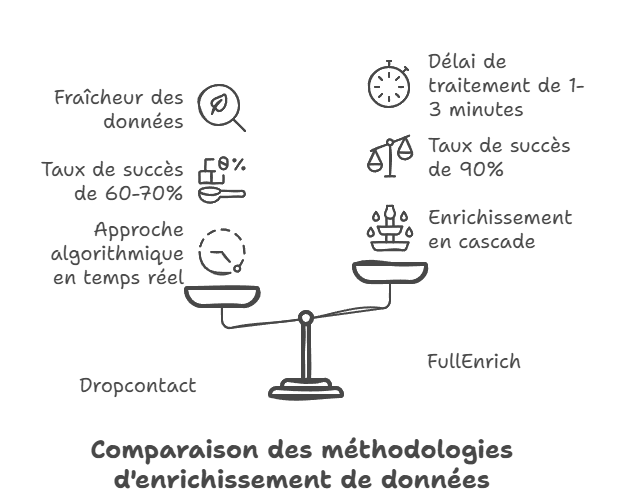
Dropcontact stands out with its real-time algorithmic approach that relies on no pre-existing database. This proprietary technology reaches an average email address enrichment rate of between 60% and 70%. The tool verifies each email through its dedicated test servers, guaranteeing an impressive 98% rate of valid emails, which rises to 85% for catch-all domains.
FullEnrich, by contrast, works on a waterfall enrichment principle, sequentially querying more than 15 different data sources. This method lets it show a 90% success rate for identifying valid professional email addresses. The enrichment process generally takes between 1 and 3 minutes, a slightly longer wait than the real-time execution of Dropcontact's algorithm.
In terms of data quality, Dropcontact's approach offers a significant advantage regarding freshness. Each request triggers an active search rather than simply consulting a potentially outdated database. This characteristic proves particularly valuable for identifying job or company changes.
Dropcontact's method also guarantees full GDPR compliance, unlike solutions that store name-based data in databases. The proprietary algorithms generate and verify email addresses on demand, without ever storing personal information.
Geographically, Dropcontact works effectively both in France and internationally. Its algorithmic technology lets it enrich contacts in many countries with no database size limits or geographic constraints.
Ultimately, while both solutions post high enrichment rates, their fundamentally different approaches directly influence the freshness, compliance, and overall quality of the data provided, essential factors to consider beyond features and pricing alone.
Conclusion
The fundamental differences between Dropcontact and FullEnrich reflect two distinct philosophies of B2B data enrichment. On one side, Dropcontact's real-time algorithmic approach guarantees up-to-date data and full GDPR compliance. On the other, FullEnrich's multi-source aggregation method offers broader coverage for certain types of data, notably phone numbers.
The choice between these two solutions essentially depends on each company's specific needs. Organizations that prioritize data freshness and regulatory compliance will be well served by Dropcontact. Those seeking broad phone data coverage will naturally lean toward FullEnrich.
Pricing structure is also a decisive factor, with each platform offering models suited to different scales of use. The impressive performance of both tools, with success rates above 85%, speaks to their effectiveness in enriching professional data. Enrichment is only one building block: to orchestrate it with AI, Clay goes further, and our guide to B2B prospecting tools puts these solutions back into the context of a complete stack.
FAQs
Q1. What is the main difference between Dropcontact and FullEnrich? Dropcontact uses real-time algorithms to generate information without a database, while FullEnrich aggregates data from more than 15 different providers.
Q2. How do the two platforms handle GDPR compliance? Dropcontact is 100% GDPR compliant because it does not store personal data. FullEnrich, on the other hand, uses existing databases, which can raise compliance questions.
Q3. What is the starting cost to use these services? Dropcontact offers a base plan starting at €24 per month for 1,000 credits, while FullEnrich starts its pricing at €27.67 per month for 500 credits.
Q4. What are the success rates for email enrichment? Dropcontact reaches a 98% email address validity rate, while FullEnrich posts a 90% success rate for identifying valid professional email addresses.
Q5. Are these tools suitable for small businesses and freelancers? Yes, both platforms offer accessible pricing and features suited to small teams and freelancers, while also providing solutions for large companies.