
GTM · Finding your first 10 paying customers
1. Why your first 10 get sold by hand
When Airbnb started out, nobody was signing up anymore. Brian Chesky and Joe Gebbia got on a plane, flew to New York, and knocked on hosts' doors to take photos of their apartments. Not a marketing strategy: a manual act, done one host at a time. A few weeks later, the listings with their photos were flying off the shelf. The rest of the world would call that a growth operation. They just called it "doing what needed doing".
When Stripe started out, the Collison brothers did something almost unbelievable. When someone showed a flicker of interest, they didn't send them a link to the docs. They asked for their laptop, opened a terminal, and installed the SDK for them. Patrick later called it the "Collison installation". Today Stripe is worth a hundred billion. Back then, they were just the two guys installing their own product on their users' machines.
If you're starting now, you're about to live that exact moment.
One objective at this stage
You have a pyramid. You have a problem that keeps coming up for several people. You may already have a scrap of product, a Notion, a landing page, a clickable Figma. Now you need people to pay for it. Not to like it. Not to think it's clever. To pull out a card, sign a quote, or send a wire.
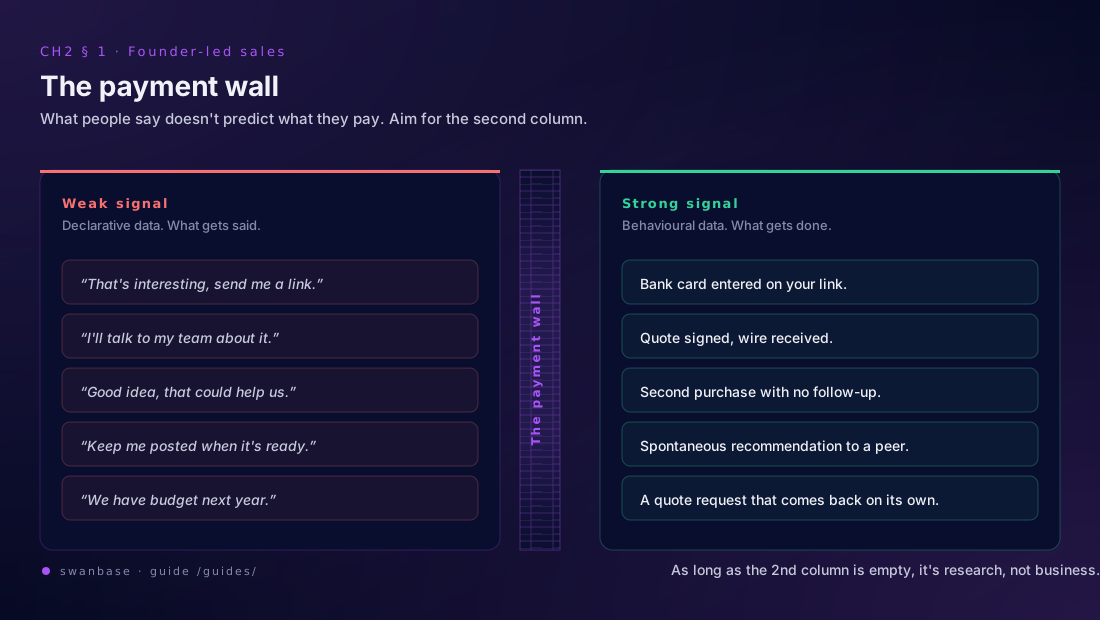
This is the single most important line in your whole first year. On the left: "that would be cool". On the right: "here, it's paid for". Between the two there's a wall you won't cross with a website, a LinkedIn post, or an automation. You'll cross it by hand, ten times, so you can describe it to someone else afterward.
Paul Graham wrote an essay about this in 2013, "Do Things That Don't Scale". The title has become a startup cliché, but the idea stayed true: most founders die waiting for something to happen on its own. The ones who survive force it to happen, one customer at a time, until the pattern is clear.
The goal of that first sale isn't the revenue. It's the information.
Ten payments against a hundred interviews
An interview is declarative data. Someone tells you "yes, I'd pay for this". You have no way to know whether it's true. Politeness, projection, curiosity, the fear of offending you, the urge to seem interesting: there are ten reasons to look convinced without being convinced.
A payment is behavioral data. Someone put their money down. They weighed the cost of the product, the cost of the setup effort, the risk of looking foolish in front of their team, and they decided it was worth it anyway. That's no longer an opinion, it's a decision.
The difference between the two isn't visible until you've lived both. That's why you need to aim for the payment fast, even a small one, even a hacked-together one, even from a single customer. As long as nobody has paid, you're doing user research, not business. And user research can go on forever without anything happening.
Ten paying customers is the minimum threshold for you to start seeing whether it's an accident or a pattern. Below that, you can always tell yourself a story ("that customer was a special case", "they did me a favor"). Above it, chance no longer holds up.
"By hand", concretely
Selling by hand isn't a metaphor. It's:
- Identifying one specific person in your target.
- Reaching out directly, by DM, by email, in person, at an event.
- Talking to them for an hour, understanding their exact context.
- Presenting your solution tailored to their case, not to an average case.
- Helping them set it up yourself, right next to them, over screen share if you have to.
- Collecting a first payment, even a symbolic one.
- Doing it again.
None of these steps scale. That's precisely why they work at this stage. You learn what goes on in the buyer's head between "oh, interesting" and "OK, I'll take it". You'd never have gotten that information by blasting out 500 cold emails.
The trap to avoid is inventing a system too early. A website with a checkout, a CRM that tags leads, an automated onboarding workflow: those are the sound instincts of a founder who has already sold a hundred times. When you haven't sold to anyone, those tools serve to hide you. The open terminal is more uncomfortable, and that's exactly why it works.
The three traps when you shift into selling mode
You'll run into three of them.
The widening trap. You start talking to prospects and you think "hmm, this profile could work too, and so could that one". You end up with a list of ten segments and zero customers. Stay on the target you chose in the pyramid. It doesn't have to be the right one forever, just the right one for now. You widen later, once you know how to sell to a specific segment.
Free. Someone tells you "give it to me, I'll give you feedback". It's tempting. Part of you just wants the "yes". But a free user gives you almost no information about value. They give you nice-person feedback. You can run a low-priced paid beta, or a deal like "you pay, and if you're not happy in two weeks I'll refund you". Anything but free, because free doesn't trigger the decision you care about.
The premature industrialization trap. You sell to two people, and you start coding the self-service portal, writing the pricing page, configuring Mailchimp. Stop. None of that is urgent until you've repeated the sale enough times to know exactly what needs industrializing. Otherwise you'll automate something that never worked.
This week's exercise
Open a file and write these four lines:
The four lines of the week
- Precise targetone segment, not three
- Named list10 people I can contact this week
- Promise in one sentenceproblem → result
- Price v1in euros, even rough
If you can't fill in the named list, it's not a positioning problem. It's that you haven't talked to enough people in your target yet. Go back to the previous section, talk to ten more people, then come back here.
If you can't put a price down, put one down anyway. You can lower it later, you can raise it later. But without a price you don't have a sale, you have a free demo.
Before you move to section 2
This first shift into selling held up when three things are true at the same time:
- At least a handful of people paid from their bank account.
- When you describe your product to a stranger, you often see the same reaction.
- When someone says "no", you can name the reason without making it up.
If all three are there, the problem becomes "how do I find ten more people like these, without starting from scratch every time". That's exactly the question in the next section.
2. Choosing your motion (PLG, sales-led, community, outbound, inbound)
Salesforce started in 1999 with a simple motion: an AE (account executive) on the phone, a demo, a quote, a signature. Twenty-five years later, the company is worth hundreds of billions and still works roughly the same way. The ticket is big, the cycle is long, the buyer wants to see someone across the table before putting a card down. Salesforce was right.
Stripe started ten years later with a radically opposite motion: no salespeople for a long time, just docs, an SDK, and the ability for a developer to integrate the product in an hour from their couch. Not a quote, not a call, not a signature. Bank card, API key, off you go. Stripe today is worth an amount comparable to Salesforce. Stripe was right too.
Both won. With two opposite motions. Because the motion follows from who buys from you.
The wrong question
You're going to ask yourself, legitimately: "what's my motion going to be, PLG, sales, community, outbound, inbound?" That's the wrong question. It puts you in the position of an aesthete picking what they prefer, or a copycat imitating the motion of a company they admire.
The right question is more down to earth: who pays me, how much, and how does that person decide?
Once you've answered that honestly, the motion falls out almost on its own. You don't choose it. You read it.
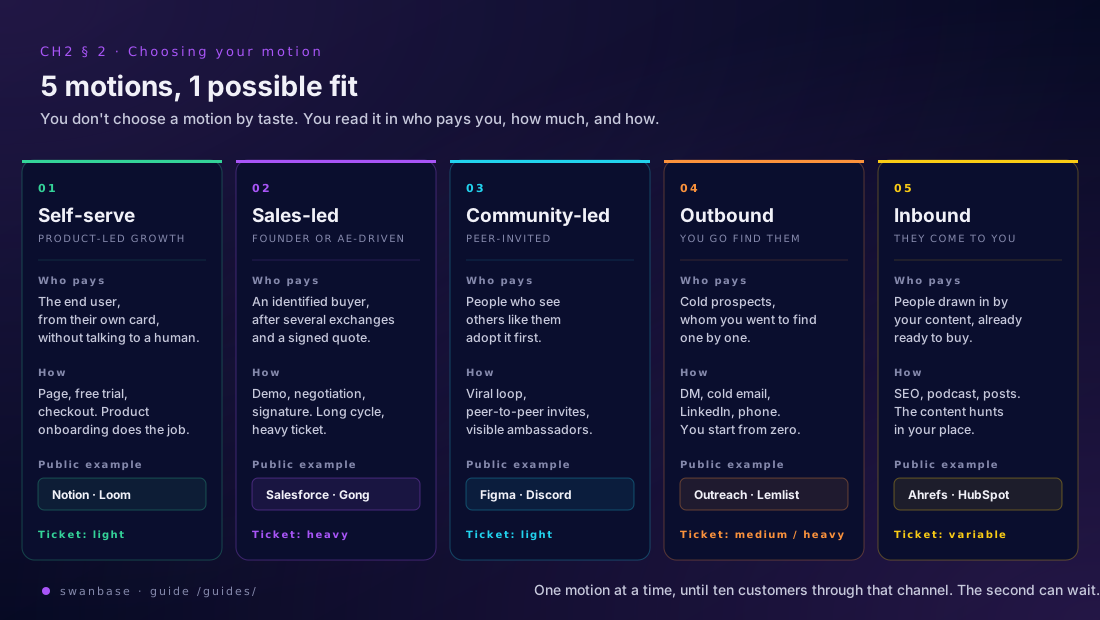
The 5 base motions, in plain terms
There are a lot of names floating around in the growth literature. At your stage, you only need to know five.
1. Self-serve (Product-Led Growth). The end user discovers your product, tries it without talking to you, and pays without talking to you either. You have no salesperson. You have a page, a product simple enough to grasp in two minutes, and a checkout. Public examples: Notion, Loom, Calendly in their early days.
2. Sales-led. An identified buyer inside a company meets a human from your team. There's a demo, a conversation about the need, a quote, sometimes a negotiation, then a signature. The annual ticket justifies the human time. Public examples: Salesforce, Gong, most "enterprise" B2B SaaS.
3. Community-led. Your customers bring in other customers because your product makes more sense used by several people, or because it lives in a community of peers who recommend it to each other. You don't have to chase them, they invite themselves. Public examples: Figma (a designer opens a file with a colleague, the colleague creates an account), Discord (a server that adopts it = N new users), Notion via its ambassadors.
4. Outbound. You go out and find cold prospects one by one. DM, email, LinkedIn, phone. You start from zero in every conversation. This is your motion when your buyer doesn't know they have a problem, doesn't hang out online where you publish, and won't stumble onto your product by accident. Public examples: early Outreach, early Lemlist, nearly every early-stage B2B startup before inbound takes off.
5. Inbound. You create content, SEO, posts, talks, and the people who already have the problem come find you. You flip the relationship: your content attracts in your place. Public examples: Ahrefs (all their growth comes from SEO on SEO queries), HubSpot (the company that invented the word "inbound" fifteen years ago), every founder who puts out a useful podcast and ends up signing customers who had been listening for six months.
Three questions to read your motion
Ask yourself these three questions about the buyer you identified in chapter 1.
Question 1: can they buy on their own, without asking anyone?
If the buyer is also the user, and they can pull out a card or click "try for 14 days" without approval from a manager, a purchasing committee, or an IT department, you're a candidate for self-serve. If the purchase runs through an approval chain, forget self-serve: you need someone on your side to carry the deal.
Question 2: is your annual ticket light or heavy?
Light means the cost to your customer sits in a range they can sign off without a pre-approved budget (typically a few hundred euros a year, sometimes a thousand). Heavy means it needs a budget, a business case, maybe a formal tender. Light: self-serve or community. Heavy: sales-led or outbound. In between: you're going to live a painful hybrid for a while, and that's normal.
Question 3: does your buyer already spend their day in a space you can reach without paying?
If they live on LinkedIn in a visible professional niche, in a Discord of peers, in identifiable Reddit forums, at an annual conference that gathers the profession: you have ground for community or inbound. If they exist nowhere as an identifiable group (because the role is obscure, the company small, the problem confidential): you're going to do outbound, full stop.
These three questions don't hand you a single motion. They eliminate the motions that have no chance of working for you. You end up with one, two, or three candidates. You pick one to start with. We'll cover how below.
Stripe and Salesforce, reread through the three questions
Stripe in 2010: the buyer is a developer or a technical founder. They can integrate an SDK without asking anyone (Q1 = yes). The ticket varies but the entry point is very low, a few cents per transaction (Q2 = light). And developers live on GitHub, Hacker News, tech Twitter (Q3 = yes). Self-serve + community-led + a bit of technical inbound, that's what they did. When the enterprise ticket became heavy, they added sales-led alongside it, but not before.
Salesforce in 1999: the buyer is a head of sales equipping a team of twenty. They can't sign a six-figure contract without a meeting (Q1 = no). The annual ticket is heavy (Q2 = heavy). And those sales directors weren't hanging around on the internet in 1999 (Q3 = no). Sales-led, 100%, from day one. No other reasonable choice.
You see the pattern. The motion wasn't chosen out of aesthetics, it was dictated by the three answers.
The double motion
You'll be tempted to launch two motions in parallel "to give myself the best odds". It's almost always a mistake at your stage.
Here's why: each motion has its own toolbox, its own vocabulary, its own rhythm. Sales-led needs a CRM, call scripts, a follow-up cycle. Self-serve needs a landing page you maintain, a product onboarding, a measured funnel. Community needs animation, patience, shareable content. Inbound needs a publishing calendar you actually keep. Outbound needs a list, sequences, and rejection to digest.
You have neither the time, nor the attention, nor the money to run two motions seriously in your first year. If you launch two, you'll do 50% of one and 50% of the other, and neither will reach the threshold where you know if it works. You'll have spent six months without reading a single clear signal.
One motion at a time, until you have ten paying customers through that channel. Only then do you consider the second.
When you're torn between two candidates
If the three questions leave you with two plausible candidates (for example "it could be self-serve, it could be outbound"), pick the one with the shortest learning cycle.
Concretely: which of the two will tell you in four weeks whether it works or not. Outbound tells you fast (fifty DMs and you know whether you have zero replies or five meetings). Self-serve does too, provided you have a testable product (twenty visits and you know whether anyone tries it). Sales-led takes three months minimum because of signature cycles. Inbound takes six months minimum because of how long content takes to rank.
At the first-10-customers stage, you choose the motion that gives you signal fast, not the one with the biggest theoretical ceiling five years out. The ceiling doesn't matter until you've proven the floor exists.
This week's exercise
Take your precise target from chapter 1. Answer the three questions in writing, one sentence each.
Three questions, one sentence of answer each
- Can my buyer buy on their own, without approval?
- Is my annual ticket light, medium or heavy?
- Does my buyer hang out somewhere identifiable as a group?
- My motion v1one only
- My reasonone sentence
If you can't answer a question, that's a signal you haven't talked to your target enough. Go back to chapter 1, redo five interviews focused on "how you last bought something similar", then come back here.
Before you move to section 3
Your motion v1 holds when three things start happening repeatedly:
- You describe your product to a stranger through your chosen channel, and you get the same kind of reaction several times in a row (interest, or the same objection).
- You close at least one customer through the same path several times.
- You can say out loud: "I find my customers through X, it takes me Y hours per customer, and it works Z times out of 10."
When those three things are true, you're no longer testing a motion: you have one. The next section is about price. Because figuring out how to reach them is worth nothing if you haven't yet set what they pay in exchange.
3. Pricing v1: the least-wrong price possible, as fast as possible
Joel Gascoigne started Buffer in 2010. A tool that schedules Twitter posts, nothing revolutionary, already existing elsewhere. Joel did something half of founders never do: he set a price within the week. Five dollars a month, single plan, checkout page in place. Someone paid. Six months later, he doubled the price. Nobody left. Today Buffer publishes its revenue transparently, several million a month, and has for years. The lesson isn't "five dollars is the right price". The lesson is that Joel set a price early, held it, learned from it, and adjusted it.
The opposite story, you'll run into it a hundred times this year. The founder who's "still thinking about pricing", who wants to "see how it goes before putting a number on it", who launches "a free six-month beta to gather feedback". Six months later, they have thirty users who love it and zero who pay. They've lost six months.
Pricing v1 isn't a smart decision. It's a fast one.
Free does more damage than a wrong price
When someone pays, even badly, they leave the "I'm looking" zone and enter the "I'm deciding" zone. That transition is exactly what you want to observe. Without it, you know nothing.
A free user gives you fake signal. They love it, they use it, they invite their colleagues, and they'd never pay. They have no skin in the game. The moment the service asks anything of them (a password, two minutes of onboarding, a bit of configuration effort), they'll leave without a word. You'll conclude your product has a usage problem. The problem lies elsewhere: your product never had a price.
A wrong price, on the other hand, teaches you something. If it's too high, people grumble and you see which ones. If it's too low, you see what they buy without thinking and you know you can go up. Either way, you learn in two weeks what a free user would never have told you in six months.
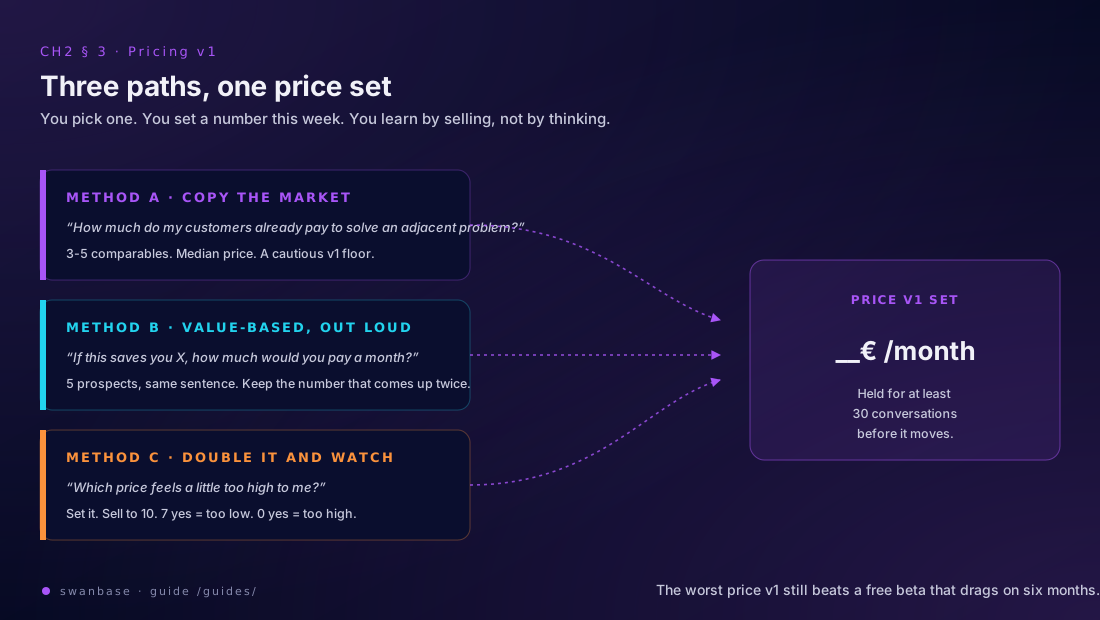
Three pragmatic methods to set your price v1
None of them is "the right one". You pick one, put down a number, and start selling.
Method A: copy the market. Find three to five tools your buyer already pays for to solve a problem adjacent to yours. Note their prices. Take the median. That's your floor for v1. This method is reassuring because it calibrates you against an already-accepted norm. Its flaw: if your product creates more value than those tools, you'll undersell yourself. Use it when you're starting out and want to avoid being wildly off target.
Method B: value-based, out loud. Ask five prospects in your target the same sentence: "if this saves you X hours a month (or Y euros, or Z critical errors), how much would you be willing to pay to use it?". You'll get five very different numbers. Take the one that comes up at least twice. This method is more precise because it connects you directly to perceived value, but it requires that you've already talked to your target and can express your promise as a measurable gain.
Method C: "double it and watch." Set the price that feels a little too high. Sell it as-is to ten people. If seven say yes without flinching, you were too low and you'll go up again. If zero say yes, you were too high and you come down a notch. In between, you've started reading your market. This method is uncomfortable but it's the fastest to give you usable signal.
The criterion for choosing: whichever blocks you the least. The worst option is not picking one.
Packaging v1: a single plan
Bronze, Silver, Gold is a classic SaaS reflex. At your stage, it's an anti-pattern. You don't have enough features or enough signal to build three coherent tiers. You'll paralyze your prospects (analyzing multiple options burns more brain than it helps you choose). And above all, you'll scatter yourself across three personas instead of serving one perfectly.
One plan, one price, one promise. If someone wants "the Enterprise plan", you answer "call me" and you do custom work by hand. Above all, no pricing page with three columns when you've sold to nobody.
As a bonus, your site will breathe, your promise will become legible, and your sales conversations will go twice as fast.
Prolonged free
A free beta that lasts more than two or three weeks is pure debt. Your users get used to free, they'll grumble when you switch to paid, and you find yourself arguing against people you yourself conditioned not to pay.
Two clean alternatives:
Symbolic paid beta. You set a deliberately low price (you judge the order of magnitude, the idea being that it triggers the decision without killing the trial). It's enough to filter the curious from the decided, and you have your first real payment.
Money-back guarantee. You charge full price. If the person isn't happy within two weeks, you refund without argument. You get the purchase decision (so the signal), and you reduce the risk on the customer's side.
Anything but free, because free doesn't send the signal you care about.
Pricing isn't a divorce
You can raise your price next week. You can lower it in a month. You can move from monthly to annual to usage-based in six months. You're not married to your price v1, you're married to the idea of having a price.
The one somewhat serious rule: hold it for at least thirty conversations before moving it. Below that, you don't have enough signal to know whether you were too high or too low. You'll drop it at the first bit of friction, and you'll have learned nothing (you'll just have learned that a human resists saying "no").
This week's exercise
Open a file, write:
Your price v1, set today
- Price v1number + unit
- Method usedA market · B out loud · C double it
- Single plan, promise in one sentence
- Review conditions30 conversations or 10 paying customers
Set the price the same week. Not the week after.
Before you move to section 4
Three things are true at the same time:
- You have a price set, written down, sayable out loud in one second.
- At least ten people have heard that price in a real conversation, not on an abandoned web page.
- You know which ones paid and which ones said no, and you can name the reason for the no without making it up.
If yes to all three, you have what you need to go chase an acquisition channel more systematically. That's the subject of the next section.
4. Channel-market fit: test three channels, double down on the best one
Gabriel Weinberg, founder of DuckDuckGo, published a book in 2014 whose title became a classic: Traction. With Justin Mares, he lays out a list of nineteen possible acquisition channels for a startup. Nineteen. The list covers SEO, conferences, targeted ads, podcast sponsorships, engineering as marketing, viral, offline content, PR, and a dozen others. The book's thesis fits in one sentence: most startups die because they use a random channel, test it badly, and never know whether they'd have done better somewhere else.
You have the same trap waiting for you. You've chosen your motion (previous chapter). You have your price. You know who you want to reach. Now you have to decide which way to go in. And the worst strategy is to attack the channel that feels "natural" without having compared.
Why the "natural" channel is rarely the right one
An ex-marketing founder will attack LinkedIn and inbound because that's where they're comfortable. A developer founder will launch an open-source repo and wait. A founder who loves to talk will push themselves to make a podcast. Each finds in their personal history a reason to go where they already know how to go.
The problem: you're not looking for the most comfortable channel, you're looking for the one where your buyer spends the most time and listens the best. It's almost never the same one.
The right channel, at your stage, is the one that brings you one customer a week with a sustainable effort. Not the one where you have the most followers, nor the one with the weakest competition. You discover it by testing, not by imagining.
The nineteen Traction channels, in plain terms
Weinberg and Mares list these channels in 2014. The list is still applicable, we've just modernized it a bit. For each one, the idea is to ask "is my buyer here, and can I show up without paying a fortune?".
- Viral word of mouth (the product grows the product)
- Public relations / trade press
- Unconventional PR (stunts, memorable cases)
- SEM / intent-based ads (Google Ads)
- Social ads (Meta, LinkedIn, TikTok)
- Display ads
- Offline ads (billboards, radio, print)
- SEO (content + organic ranking)
- Content marketing (blog, podcast, video)
- Email marketing (opt-in list, newsletter)
- Engineering as marketing (a free tool in the service of your brand)
- Targeting blogs / online niches
- Business development (partnerships)
- Sales (founder-led or AE)
- Affiliate programs
- Existing platforms (App Store, marketplaces, integrations)
- Trade shows
- Offline events (meetups, conferences organized by you)
- Speaking engagements (speaking at existing conferences)
You don't test nineteen. You pick three.
The Bullseye Framework, simplified version
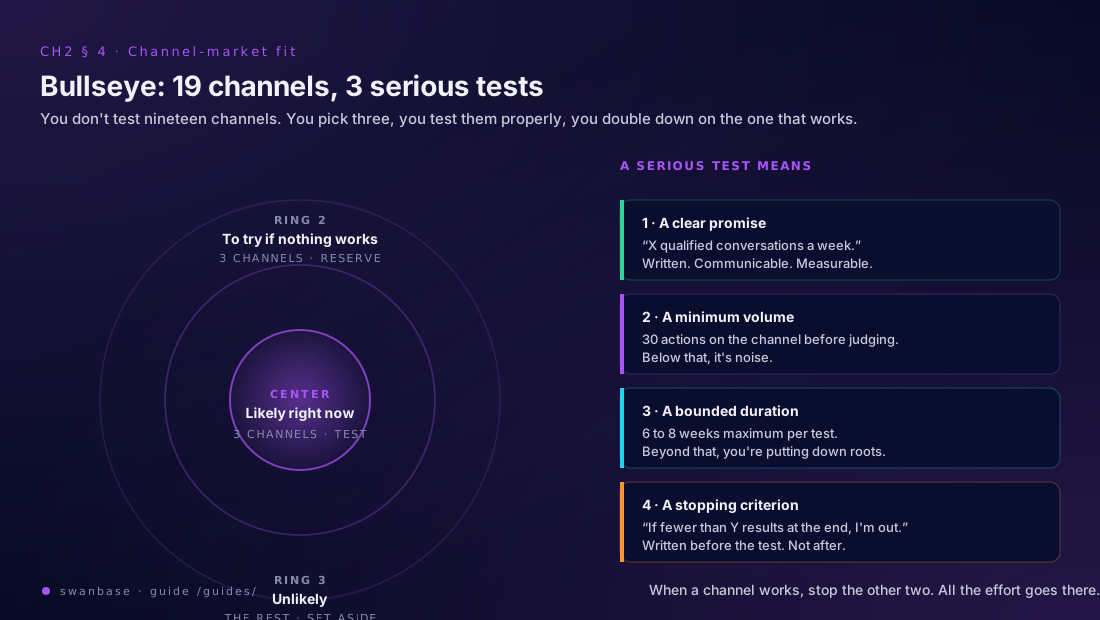
Weinberg & Mares propose a simple device called the Bullseye. Three concentric rings.
Ring 1 (the center): "likely right now". Three channels where your buyer is probably present, where you can probably show up without a big budget, and where you believe conversion is plausible. Those three channels, you test seriously (six to eight weeks each, in parallel if your means allow, otherwise in series).
Ring 2: "to try if nothing works". Three secondary channels that require more effort or more luck. You keep them in reserve.
Ring 3: "unlikely". The rest. You set them aside for now.
The classic mistake is putting five or six channels in the center because "they all look good". Three channels at most. A human brain can't steer seven bets in parallel.
How to test a channel seriously
Testing doesn't mean posting on LinkedIn once and concluding it doesn't work. A serious test is:
A clear promise. You write in one sentence what this channel is supposed to bring you: "X qualified conversations a week", "Y product trials a week", "Z discovery calls a month". Without that line, you won't be able to say whether the test worked.
A minimum volume. Thirty actions on the channel before judging. Thirty cold DMs. Thirty posts if you're doing content. Thirty conversations at a trade show. Thirty is the low threshold at which statistical noise starts to drop.
A bounded duration. Six to eight weeks maximum per test. Beyond that, you're no longer testing, you're putting down roots. That's different.
A stopping criterion. Before you start, you write: "if by the end of X weeks I have fewer than Y results, I move to the next channel." Otherwise you'll find a thousand reasons to keep going on a channel that doesn't work.
Doubling down when a channel starts to work
A channel gaining traction shows three signals:
- You get repeatable results (not one isolated lucky break).
- The cost per customer (in time or money) holds up against your price.
- You feel, in your gut, that you could do twice as much without wrecking your schedule.
If all three are there, stop the other two tests and put all your time on that one. Keeping your energy split three ways when one channel works is leaving money on the table.
The mirror trap: you'll be tempted to get bored of a channel that works and go chase something new. Resist. A channel that works is worth mining for a year before you add a second.
Premature multi-channel
Once your main channel produces results, you'll want to "diversify the risk" by launching a second channel. Too soon.
Multi-channel is expensive: twice the complexity, twice the tracking, twice the split attention. You can't hold a serious cadence on two channels until the first has become second nature.
The rule: you add a second channel when the first runs on its own (team in place, written process, or a tool that takes over). Not before.
This week's exercise
Take the list of nineteen channels. For each one, give a score from 0 to 3 on two criteria:
A score from 0 to 3 on each criterion, channel by channel
- Criterion A · is my buyer here?0 absent · 3 they live here
- Criterion B · can I show up without a big budget?0 impossible · 3 easy
Channel score = A + B (0 to 6)
Keep the three highest-scoring channels. For each, write your promise, your volume, your duration, your stopping criterion. Launch all three starting next week.
Before you move to section 5
Your channel is viable when:
- You get one customer a week through this channel, no miracle needed.
- You can name the cost (in hours or euros) per customer acquired.
- You can describe your process in five steps to a stranger without hesitating.
When those three things are true, you've started to industrialize the channel. What's left is to look at one motion in particular that deserves detailed treatment because it's underrated: founder-led outbound, by hand. That's the subject of the next section.
5. The "100 cold DMs" playbook: your founder-led outbound, by hand
Before Airbnb was Airbnb, Brian Chesky sent personalized messages to every new host who signed up in New York. Not an automated email sequence. Not a marketing tool. Him, at his keyboard, at two in the morning, writing a different paragraph for each person. Half the hosts didn't reply. The other half did. Brian kept what made people reply, and he iterated. Over the first three years, those manual messages grew the platform faster than any paid campaign.
Patrick Collison, around the same time, did something very similar for Stripe. He wrote to founders of other YC startups to pitch them on integrating Stripe before anyone was talking about it. No sequence, no tool, just a short email tailored to each recipient.
This is the most underrated channel of early B2B: you go find your first prospects one by one, by hand, with a message you could send them without blushing if you ran into them the next day. It's called founder-led outbound. A hundred DMs, not five thousand. And it works precisely because there are so few.
Why "a hundred" is the right number
Too few, and you have no statistical signal. You'll draw conclusions from three conversations and lie to yourself.
Too many, and you lose the quality. Past a hundred personalized DMs, you'll inevitably fall into copy-paste, templates, mass mailing. At that point it's no longer founder-led outbound, it's classic outbound. The reply rate drops, your recipients smell the template from ten meters away, and you wreck your reputation on the channel.
A hundred is the test unit. You send a hundred, you observe, you learn, and you settle what gets industrialized and what stays manual for the next hundred.
The three-beat script
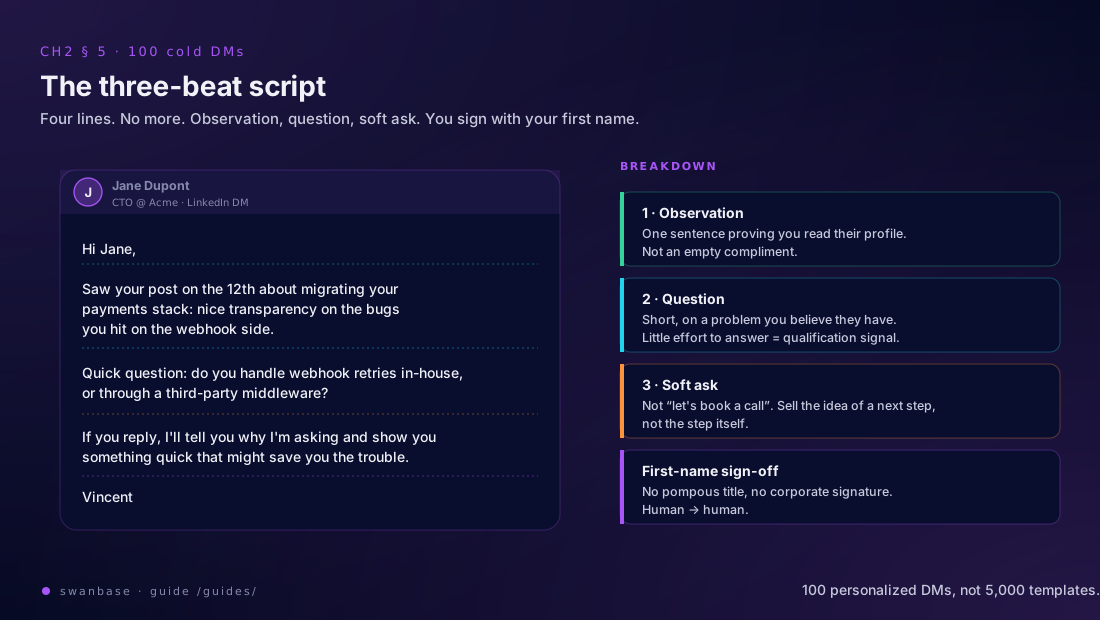
A good cold DM fits in four lines. No more. If your draft runs to ten lines, you haven't yet understood what you're selling. Three beats, plus a sign-off.
Beat 1: observation. One sentence that proves you made the effort to read their profile, their site, their recent post. Not an empty compliment ("I admire your career"), a concrete observation ("I saw you talked to TechCrunch in March about your Berlin raise"). If you can't write this line for this specific person, you shouldn't have put them on your list.
Beat 2: question. A short question about a problem you believe they have. Not "how are you", not "I'd love to chat for ten minutes". Something like "do you handle payments directly on Stripe or through a partner?". The question does two things: it takes little effort to answer, and it gives you an almost immediate qualification signal.
Beat 3: soft ask. Not "let's book a call". Something small. "If you reply, I'll tell you why I'm asking and show you something that might interest you, no heavy demo." You're selling the idea of a next step.
Close with your first name. No "Sales Manager at X", no long corporate signature. You're a human talking to a human.
Choosing the channel, on par with the message
Not all channels are equal depending on your target.
LinkedIn DM. Good for identifiable B2B roles (founders, marketing, ops, sales, HR). Bad when your target barely uses LinkedIn (devs, very technical roles, some field jobs).
Twitter / X DM. Very good for tech founders, indie hackers, content creators. Provided you have a non-empty X profile and your contact is open to DMs or a possible follow-back.
Direct email. The most universal, but also the most crowded. Requires clean email-extraction work (tools like Apollo / Hunter / Clay 2024-2026, to choose based on budget and target).
Community Discord / Slack. Excellent when your target lives in an identifiable topical community. Bad if you drop in without having contributed: you'll be read as a spammer in three seconds.
Direct phone. Underrated in 2026, especially for heavy tickets. A lot of people don't pick up anymore, but the ones who do will give you in eight minutes what an email would have taken three weeks to get.
Pick one main channel, two secondary channels. No more at this stage.
The GDPR framework, in two sentences
For B2B messages, in France and Europe, cold email is legal under legitimate interest provided that (1) the recipient has a role clearly tied to your offer, (2) your message includes a simple, clear opt-out, and (3) you stop immediately if the person asks not to be contacted again. The CNIL has published its position on this, and it's been stable for several years [to source: CNIL position on B2B cold email 2024-2026, verify the reference text currently in force].
For messages to individuals (B2C), it's the reverse: prior opt-in required. At this stage you're probably not doing B2C cold DMs, so you don't have the problem, but know it.
No gray area: you include the opt-out, you honor the withdrawals, you archive the proof.
Five fatal mistakes in a cold DM
The visible template. "Hi [FIRSTNAME], I hope this email finds you well" is read in two seconds as a template. Nobody replies.
The missing observation. You go straight at your product without proving you know who you're writing to. The recipient concludes they're part of a list of a thousand.
The too-big ask. "Let's book a 30-minute call" is an enormous ask for someone who doesn't know you. Soft ask, always.
The disguised pitch. You ask a fake question you already know the answer to, just to lead into your product. People sense it. Don't do this.
No follow-up. A brief follow-up ("just bumping my message") a week later almost always doubles the final reply rate. Not doing it means leaving half your signals on the table.
This week's exercise
Block an hour and a half tomorrow morning. Not three hours, an hour and a half. You're going to send thirty DMs.
Thirty DMs in an hour and a half
- List 30 named people in my targetone segment only
- Choose the main channelLinkedIn · X · email · Discord
- For each one, write observation + question + soft askthree lines
- Send
- Track sent, read, replied, meeting bookedfour columns
If you can't find a different observation for each person, it's not a time problem. It's that you haven't chosen a precise enough target yet. Go back to chapter 1.
Before you move to section 6
Your founder-led outbound holds when:
- Out of your hundred DMs, you have at least five to ten serious conversations.
- Out of those conversations, you can name what moves them from "interested" to "meeting".
- You can write the DM that works for your target without thinking.
When those three things hold, you have a manual channel that brings in qualified prospects. What's left is to see how you onboard them and how you learn when one of them says no, which is the subject of the next section.
6. Onboarding by hand + learning from the first no
Patrick and John Collison, founders of Stripe, had a habit that would make any founder in 2026 go pale. When someone showed a bit of interest in integrating Stripe, they didn't send them a link to the docs. They asked for their laptop, opened their terminal, and installed the SDK themselves, on the spot or over screen share. Paul Graham later dubbed it the "Collison installation". Today Stripe is worth hundreds of billions. Back then, they were just the two guys installing their own product on their users' machines.
You're going to do exactly that during your first ten customers. You're going to install your product on their machines. Configure their account. Import their data. Fix the bugs that show up. Write the first rule of their workflow with them. Not because you have no docs, but because you want to learn what really blocks the moment it blocks, and not by reading a support ticket three weeks later.
That's concierge onboarding.
Why you do onboarding manually, really
Three reasons.
You see what your product hides. Your interface feels obvious to you because you built it. For your customer, there are four buttons on the first page they don't understand, two vocabulary words they know poorly, and a workflow that requires clicking somewhere else first. Until you've seen it live, you won't have the intuition to simplify what needs simplifying.
You collect usable verbatims. When a customer tells you during the install "oh, I thought it would do X but actually it's Y", that's a golden sentence for your landing page, your onboarding, your post-signup email. You harvest ten of them in an hour of concierge work, you'd harvest zero reading an analytics dashboard.
You bind a human to your product. The customer who spent an hour on a video call with you setting up their account doesn't ghost you. If something breaks, they tell you. If something works, they tell you too. You build a direct line of communication that serves you for months.
Industrialization will come. Not now.
The concierge onboarding ritual in four steps
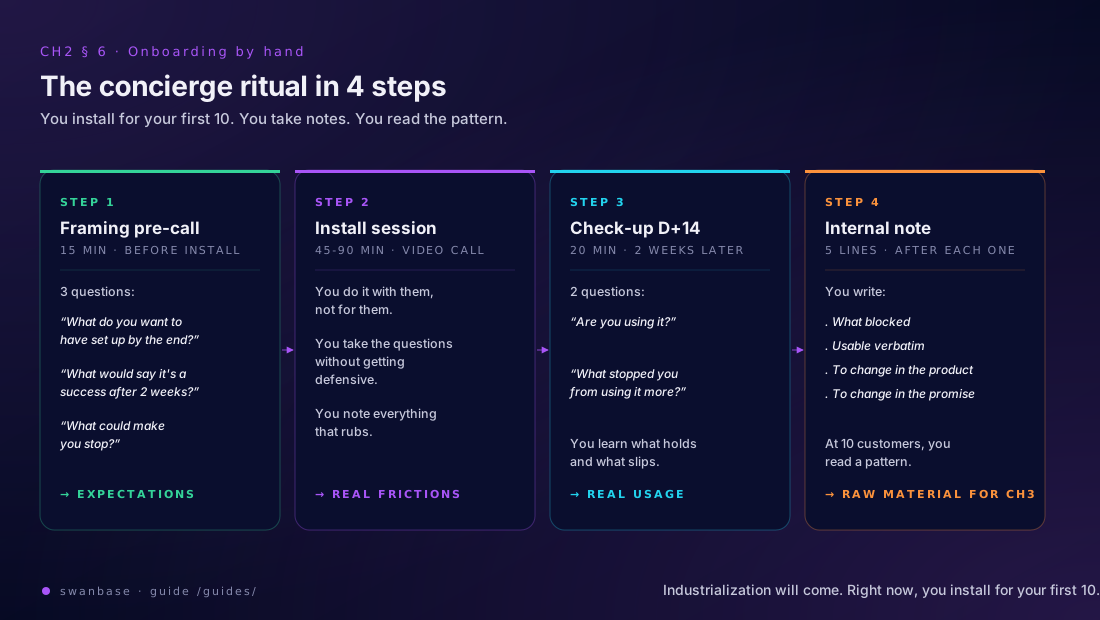
Concierge doesn't mean "improvising an hour with your customer". You follow a ritual, even a light one.
Step 1: the framing pre-call (15 min). Before the install, a short call to check that your customer clearly understood what they're going to do with your product. You ask three questions: "what do you want to have set up by the end of the session?", "what would make you say it's a success after two weeks?", "what could make you stop?".
Step 2: the install session (45-90 min). Shared video call, you take the keyboard or you guide them. You do it with them, not for them (unless the step is too technical). You take notes on everything that rubs. You take the questions without getting defensive.
Step 3: the 2-week check-up (20 min). You come back to them about a fortnight later. You ask two questions: "are you using it?" and "what stopped you from using it more?". If the answer to the first is no, you learn why. If yes, you learn what you could add so they use it ten times more.
Step 4: the internal note. After each session, you write five lines: "what blocked", "usable verbatim", "what I'd change in the product", "what I'd change in the promise". You accumulate these notes in a single file. At ten customers, you'll read a pattern.
The postmortem of the first no
You're going to lose prospects. Five out of ten at the start, that's normal. The question isn't how to avoid the no. The question is how to learn from the no.
When someone tells you no, you don't walk off with a shrug. You ask them three short questions, in this order.
Question 1: "At this stage, you'd rather not move forward. What's behind that?" The phrasing matters. Not "why are you refusing", because you get defensive politeness. Not "what was missing", because you get a list of features. "What's behind that" surfaces an emotional reason, almost always the actual reason.
Question 2: "If you had to move forward on this in three months, who would you talk to first about it?" Three things happen: either the person names a competitor (you learn who beats you), or they say "I don't know" (you learn that your segment doesn't know how to solve its problem), or they name a consultant or a manual approach (you learn you're seen as a tool for work that's still done by hand, so your challenge is educational).
Question 3: "Do you know anyone in a situation similar to yours? My thing might speak to them." If you ask this question after a no, to your surprise, half of people give you a name. The no just says "not for me right now". Asking for a referral is free.
You note the answers. You accumulate the reasons. At ten nos, you'll see which one comes back.
The no patterns to recognize
On your first refusals, you'll typically run into four reasons:
"It's too expensive." Often translates to "I didn't see enough value to justify the price". If it's recurring, the problem comes from your demo. You're selling the value badly.
"We already do it in-house." Often translates to "I don't see how your product does better than my current Excel". If it's recurring, your proposition isn't differentiated enough from the status quo.
"It's not the right time." Often translates to "you're not showing up with a strong trigger, so I'll leave it for later". If it's recurring, you're attacking at the wrong moment in your buyer's cycle.
"We'll wait until it's more mature." Often translates to "you're too early-stage, I can't justify the risk". If it's recurring, you lack social proof (logos, testimonials, documented ROI).
Each reason suggests a different action, whether more pricing work, demo, timing, or proof. You'll iterate where it pinches.
This week's exercise
On your next three prospect meetings, do exactly this:
The ritual, on the next three meetings
- Before framing pre-call15 min · 3 questions
- During install or demo over shared video, live notes
- After 2-week check-up20 min · 2 questions
- If no postmortem3 questions
- Every time internal note5 lines
Skip no step. Especially not the internal note. You'll need it.
Before you move to section 7
Your manual onboarding held up when:
- You can say in two sentences what blocks your average customer at launch.
- You can name the most frequent reason for a no in your refusals.
- You have a file of verbatims directly usable for your landing page or your product page.
When those three things are true, you have the raw material to turn your manual intuition into a system. That's what separates CH2 from CH3. The next section gives you the exact checklist to know if you're there.
7. You're ready to move to CH3 when...
This section is deliberately short. It's a checklist. At this stage, you've framed a problem, you sell by hand, you have a price, you know your channel, you know how to onboard, and you listen to your nos. What's left is to check that what you built holds without you for a few days in a row. If the answer is yes, you can move to CH3 and industrialize what already works. If it's no, you're not behind, you're in the right place, and your next week has a clear program.
The checklist in four signals
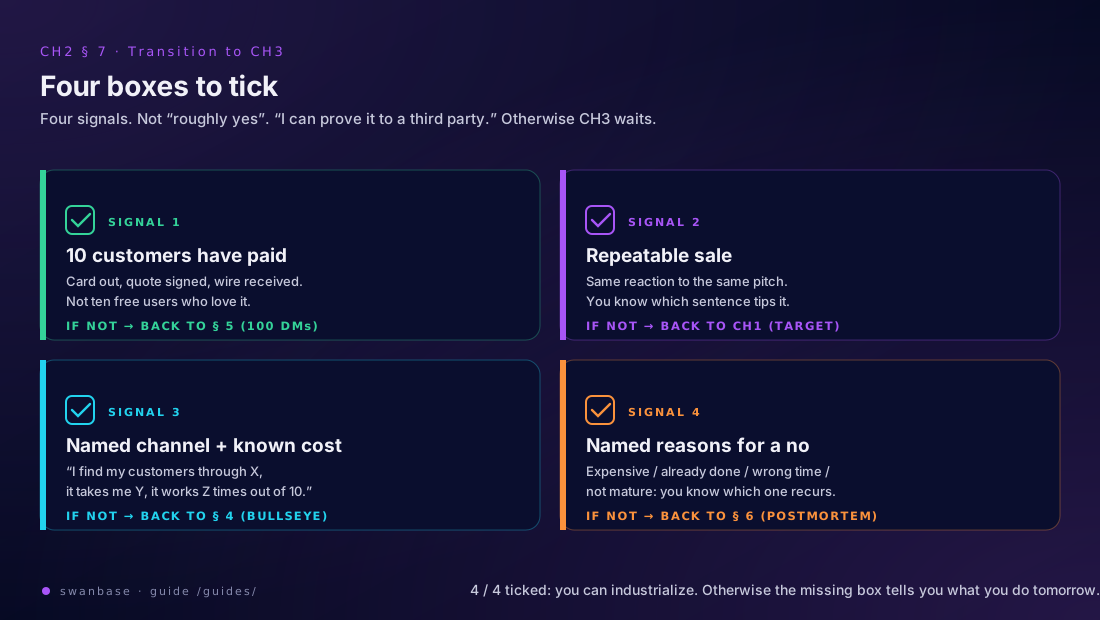
You tick each line honestly. Not in "roughly yes" mode, in "I can prove it to a third party" mode.
Signal 1: At least ten customers have paid. Not ten prospects who might. Ten customers who pulled out their card, signed a quote, wired money. This threshold isn't magic, but below it you don't have enough repetitions to tell a pattern from an accident. Not "ten free users who love it". Not "ten verbal commitments". Ten payments.
Signal 2: You can repeat your sale without making it up. You describe your product to a stranger in your target, and you often see the same reaction. You know which opening line works best. You know which objection comes back. You know which argument tips an "interested" into "OK, I'll take it". If you still hesitate at every pitch and they're all different, you don't have a promise, you have five parallel hypotheses.
Signal 3: You know your channel and its cost. An acquisition channel (your outbound, your inbound, your community-led, whatever) that brings in at least one customer a week without you putting 80% of your time into it. You can name what it costs you per customer, in hours or euros. You can say out loud "I find my customers through X, it takes me Y, it works Z times out of 10".
Signal 4: You can name the reasons for a no. You've had refusals. You've named their reasons (expensive, already done, wrong time, not mature). You know which one comes back. You know which action it calls for (pricing, demo, timing, social proof). If you haven't had a no, you haven't sold to enough people.
Concretely
If all four boxes are ticked, you're no longer in survival mode. You're not rich, you're not comfortable, you'll keep grinding, but you have proof. Proof that a precise target exists that pays for what you do, through a named channel, with a repeatable argument. From there, you no longer invent, you industrialize.
Industrializing doesn't mean "automate everything". It means turning your founder intuition into a system that runs without you in the conversation. A landing page that sells while you sleep. An outbound sequence that goes out without you writing each DM. A product onboarding that guides without you being on a video call. That's the subject of CH3.
If one of the four boxes isn't ticked, you're not behind. You're in the right place. The missing box tells you where to spend your next week.
An unticked box, what to do
If Signal 1 is missing (fewer than 10 paying customers): it's a sales problem. You haven't talked to enough people in your target. Go back to section 5, redo a hundred founder-led DMs, and come back here.
If Signal 2 is missing (non-repeatable sale): you probably haven't tightened your target yet. You're selling to three different personas with three different pitches. Go back to CH1, choose one target and one only, and re-sell to ten people of the same profile.
If Signal 3 is missing (no named channel): you're still testing too many channels in parallel, or you haven't put enough volume on a single one. Go back to section 4, choose a channel, put thirty actions on it, look at the result.
If Signal 4 is missing (unclear no reasons): either you haven't had enough nos (so you haven't sold to enough people), or you didn't ask the three questions after the nos. Go back to section 6, apply the postmortem to your next three refusals.
The end-of-chapter exercise
Write on one page:
Your end-of-chapter page
- My target1 sentence, 1 segment
- My promise1 sentence
- My price v1number + unit
- My main channel1 name
- My current volumeX paying customers, Y per week
- No reason #1reason + action in progress
- What's blocking me from CH31 sentence, or "nothing"
If "nothing" is honest, you start CH3 next week. Otherwise, the final sentence tells you exactly what to do.
The transition to CH3
What you've done so far is the more uncomfortable half of the work. Selling by hand, listening to nos, adjusting a price that felt crazy to you a month ago, getting by without a system, it's exhausting. You can congratulate yourself for getting this far. Most projects stop before their first paying customer. If you have ten, you're already part of a minority.
CH3 is going to be another world. More structured, more systematic, more "classic marketing". You're going to decouple your sales from your time. It's necessary, but it's also a trap: it's easy to hide behind tools and automations when you're afraid to talk to customers again. Keep one foot in the direct conversation, even as you industrialize. The founders who leave the concierge stage and never return are also the ones who discover one day, too late, that they no longer know why their product worked.
See you at the start of CH3.
CH2. You have your first 10 paying customers
You're no longer "validating a hypothesis". You've collected payment ten times. You can name why they signed, what you told them, and how many hours it cost you to find them.
This is the second hardest thing in the founder journey. The first was accepting to search before building. This one is facing the payment wall and not making a drama of it.
The end-of-chapter artifact
By the end of this chapter, you should be able to produce:
- Ten customers who have paid at least once. Not ten sign-ups. Not ten "very interested". Ten transactions, ten invoices, ten euros coming in.
- A clear motion: you can say "I find my customers through X". One main channel, not a blend.
- A price v1 set and defended. You can justify the number in two sentences. You know what percentage said yes.
- A concierge ritual: you onboarded your first ten by hand, you have a notebook, you know the moment they activated.
- A 4/4 ticked checklist: a motion that repeats, a defended price v1, documented onboarding, first signals of repetition (renewal, referral, upsell).
If you tick these five boxes, you have more than paying customers. You have a pattern. That's what opens CH3.
The comfort of industrializing too early
You'll be tempted to industrialize too early. You'll want to write automations, hire an SDR, launch a Stripe Checkout to "scale". At ten customers, automation pulls you away from the signal. The signal lives in the conversations you had yourself, in the sentences the first ones told you, in the frictions you saw on screen with them.
The signal that you're ready for CH3: a new customer arrives every week without you putting 80% of your time into it, through the same channel, and you can name the reason that keeps coming back.
On to CH3
You're going to decouple your sales from your time. The intent shifts again: you no longer make the sale by hand, you build the page, the content, and the outbound that bring in customers while you do something else. You're going to tighten your ICP, write your positioning in three lines, and build the page that sells.
You'll keep the founder-led hand, but on the content, no longer on the sale.